This slideshow requires JavaScript.
During my initial moments in the Auschwitz I camp, I felt confronted by the alterity of the past. As I retraced the steps of Lanzmann’s movie camera around the gas chamber and the crematorium, the words of Filip Müller echoing in my thoughts, an eerie, uncanny sense of familiarity flickered in my mind, like the furtive emanations of a signal lamp in the middle of a vast, dark sea.
The subtle combination of technology, artistry, and testimony in Shoah provides distant, fleeting glimpses into the void. Such flashes in the abyss might only further remind us of its unfathomable dimensions and the utter limitation of our knowledge. Still, they reveal landmarks: the specificity of “history” and “place” is partly (and powerfully) revealed through the details of individual memory. Most of the “tour guides” I would have liked to hear are long gone. Lanzmann’s work, in this sense, is indispensable. I wondered, too, if I should have brushed up on Primo Levi before my trip, perhaps carrying around a dog-eared copy of If This Is a Man with place-names highlighted as I navigated the camp blocks.
With the revelations of the past appearing most firmly rooted in the page, the screen, and the voice of the witness, I found myself at Auschwitz largely left to my own devices. I became, like many visitors who gaze at its ruins, a surveyor. This was my first visit to a place where I intended to build a kind of relationship
This slideshow requires JavaScript.
Blocks 14, 15, 16, 18, and 20 contained large historical exhibits from various European nations tied to the camp. Deeply engaging any one of them as an independent visitor would be a significant undertaking; with a guided tour, it’s virtually impossible. For the moment, I bracketed these displays as sites of national memory. For some, the titles were hegemonic claims:
Russia / Former Soviet Union: “Tragedy, Courage, Liberation”
Poland: “The Struggle and Martyrdom of the Polish Nation, 1939-1945”
Indeed, the Polish exhibit emphasized Nazi war crimes in graphic detail. In Block 6, the corridors were lined with photographs of Polish POWs who died in the camp. I overheard a tour guide note that the Nazis did not take pictures of Jewish prisoners. However, the implication that some of the faces on the wall were fearsome kapos (squad leaders) incentivized to brutalize the Jews remained unattended.
In contrast, the French exhibit underscored national guilt for collaboration. French deportees to Auschwitz appeared as disconcerting, immobile shadows painted on the walls. In a similar manner to the Shoah museum in Paris, the display culminated in a room full of photographs depicting French Jewish children who perished at Auschwitz.
This slideshow requires JavaScript.
I also found occasional traces of Shoah. The French exhibit made explicit reference to the film while an installation on prisoner resistance contained a photograph of Rudolf Vrba, a key interviewee. It also included a memo written by Jan Ciechanowski, the Polish ambassador to the U.S., who observed the 1943 meeting between President Roosevelt and Jan Karski, which Lanzmann explored in The Karski Report.
The museum bookstore had a collection of important works in English, including Filip Müller’s testimony, Eyewitness Auschwitz: Three Years in the Gas Chambers. Books were the only camp-related “souvenirs” available.
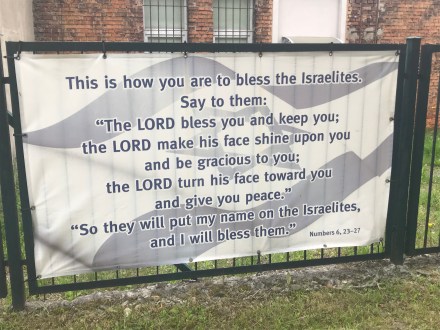
After a few hours of stock-taking, I exited the camp and ate lunch at a snack bar near the parking lot. A shuttle bus for Auschwitz II-Birkenau made its rounds as I refueled on carbs and sugar. Once again, I opted to walk as an opportunity to regroup and gather my thoughts. Along the two-mile walk from Auschwitz I to Birkenau, I passed the sign above and wondered who it was for exactly. And why was it written in English as opposed, to say, Polish? It implied a resolution to anti-Semitism in the Old Testament. And it appeared to be addressed to tourists rather than locals. Why? As a sign of Polish atonement? Or as a lesson from Israel as indicated by the flag?

While Auschwitz opened in June 1940 on the site of Polish army barracks, the significantly larger Birkenau camp was established over a year later with the clearing of the nearby village of Brzezinka. Birkenau alone was the largest and most destructive of the Nazi concentration camps. While the blocks of Auschwitz felt tightly ordered and compacted, the skeletal remains of Birkenau seemed to extend endlessly in all directions. I felt as if most of my hometown in New Jersey, only a mile square, could fit within its gates. The sheer scale of the Holocaust resonated deeply as I traversed Birkenau’s gnarled remains.
This slideshow requires JavaScript.
The remains of gas chambers and crematoria II and III, destroyed by the Nazis as the Soviet army approached.
This slideshow requires JavaScript.
Preservation work in the ruins of an undressing room. In Shoah, the camera wanders down into it as Müller narrates the ordeal facing new arrivals.
Left: The Monument to the Victims dedicated in 1967. Right: An impromptu memorial.
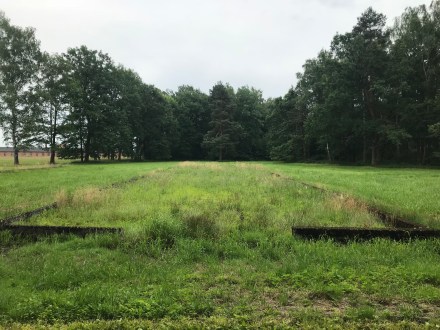
The remains of an undressing barrack.
I wandered the grounds of Birkenau for two hours, examining the major sites and diverting into less visited corners. At one point, I found myself at the edge of the camp in a field where human ashes had been disposed. On the other side of the gate, an old man slowly rode by on a bicycle as he held a shopping bag to the handle bars. We gazed at each other and exchanged a gesture of acknowledgment. “Who are you? And why are you here?” Two questions that both of our minds might have entertained simultaneously. One of the strangest and most disturbing aspects of visiting many of the camps in Poland was how daily life seemed to carry on just beyond the barbed wire fence, now as it did then.
Towards the end of my visit, I re-encountered the same group of Spanish-speaking high school students I had seen earlier that morning just outside the gate of Auschwitz I. Now, they were visiting a site in Birkenau where the Sonderkommando (Jewish special work detail) had heroically and hopelessly revolted in October 1944. As they stood looking at the remains of a crematorium damaged by the Sonderkommando, their attention remained unbowed, the same now as it had been then.


 KURT MACMILLAN, PhD