
 Broken tombstones in the Jewish Cemetery of Oswieçim, Poland
Note: In this post, I am returning to June 17, 2018 to complete my account of the day I spent in Oswieçim, Poland.
* * *
An overcast, mid-afternoon sky loomed as I sat down in a small cafeteria just outside Birkenau. Together with the adjacent bookshop and coin-operated restrooms, it served as an informal tourist depot next to the parking lot. Nearby, charter buses angled for space, their motors emitting a half-conscious rumble, as pockets of visitors ambled toward the camp gate in a polyglot swirl.
I plugged my phone into a wall socket, connected to the Wifi, and zoomed around a map of Oswieçim with my fingertips. The nagging quest for internet connectivity and battery power has become an unofficial mediator of tourist meanderings though its daily gravitational pull is all too easily forgotten in hindsight. Europe’s 3G network a mere teasing aroma, I usually had to memorize directions, street names, and landmarks before casting adrift on the streets of Poland.
As I replenished myself with a requisite dose of afternoon sugar, I calculated my next move. I had been up since 4:30 a.m. and surveying the Auschwitz and Birkenau camps on foot for the past five hours. Before returning to Kraków on an early evening train, the final act of the day was to visit Oswieçim’s Jewish cemetery.
I wouldn’t have known about the cemetery without Shoah. It makes a brief but powerful appearance in the film during an early sequence about the physical erasure of Jewish victims. At first, we see Simon Srebnik, a survivor of Chelmno, recounting the disposal of victims’ ashes in a nearby river as his fingers sift through clumps of dirt at the site of the death camp. He then sweeps his arm in imitation of the remains being carried off in the river current. Lanzmann quickly cuts to one of the film’s rare pastoral images: the camera slowly glides across the surface of the river mentioned by Srebnik during a fiery, pastel twilight. The viewer drifts downstream like the dispersed ashes of the victims while the smoldering heavens above offer a posthumous benediction.
The opaque depths of an untraceable mass grave are delineated, paradoxically, in a scene of evanescent natural beauty. This haunting juxtaposition intensifies as we hear the strains of Srebnik singing a folk song that he had been forced to perform for the Nazis at Chelmno; it is the same song that opens the film with Srebnik reenacting his duty as child entertainer on the Ner River. His return to Chelmno reanimates the past and conjures the presence of those murdered and deprived of proper burial by detailing the place of their effacement. The landscape belongs to them; indeed, it cannot stop speaking of them.
Srebnik’s arduous journey into the liminal, twilit space between past and present, however, cannot necessarily be followed by others like him. As his singing fades over the river, Paula Biren intones, “What will I see?” in response to Lanzmann’s question about returning to Poland. “How can I face it?” she asks as her visage abruptly fills the screen in an extreme close-up. Biren, a survivor of the Łódź ghetto and Auschwitz-Birkenau, left her native Poland to settle in the United States after the war. Most recently, she starred in Lanzmann’s final film, The Four Sisters as the subject of Baluty, an installment about her experiences in the Łódź ghetto. The appearance she makes in Shoah is brief but memorable. She states that her grandparents died in the ghetto and were buried in Łódź’s Jewish cemetery, which had allegedly been slated for demolition at the time of the interview—“Now how can I return to that?” The camera zooms deeper in Biren’s face, who returns the gaze. Lanzmann edits to the present-day cemetery. A crow caws and the camera slowly zooms out and pans right, revealing a vacant landscape of scattered tombstones and dried-out, overgrown weeds coated in snow. The gray chill of the desecrated cemetery contrasts the blazing river idyll of the previous scene. Yet both reveal Jewish lives violently erased, their souls deprived of proper burial and a memorial trace. The audience bears witness to what Biren cannot bear to see.
 Pana Pietyra, a resident of Oswieçim, Poland
Continuing the exposé, Lanzmann’s camera rumbles over a bridge into the town of Oswieçim (Auschwitz) under a smoky, overcast sky and the clang of a church bell. As it surveys the buildings and storefronts, Pana Pietyra, a local Polish woman, recalls that Jews constituted 80% of Oswieçim’s population before the war. The town’s synagogue was destroyed during the occupation while damage to the Jewish cemetery has left it closed indefinitely. As she affirms the existence of the cemetery to Lanzmann, the camera cuts to a slow pan of tombstones toppled against one another, almost in a state of suspended animation. “They don’t bury there now,” Pietyra remarks in a voiceover.
This brief sequence—from weightless hovering above the Ner River to stumbling through the Jewish cemeteries in Łódź and Oswieçim—has always made an impression on me. The revelation of a river as a mass grave and Jewish cemeteries still lying in ruin decades after the war is deeply unsettling. Lanzmann reminds us that the annihilation of a people involved the physical and spiritual desecration of the victims and their ancestors. And such desecration has its own particular details and afterlife. The very existence of Oswieçim, its former Jewish community, and its Jewish cemetery—all within a few kilometers of Auschwitz-Birkenau—surprised me greatly during my initial viewings of Shoah. Biren’s suggestion of Polish indifference echoed by Lanzmann’s scenes of neglect also haunted me. The query, “What does it look like now?” would eventually lead me to retrace Lanzmann’s footsteps around Poland. Since tourism had already carved a well-worn path to Auschwitz, tracking down Oswieçim’s Jewish cemetery might provide a stronger litmus test of historical memory.
Provided I could find it, of course.
 Oswieçim, Poland
I planned my moves carefully in the tourist cafeteria near Birkenau. I knew that Google Maps could still offer some guidance in the offline mode if I left it open on my phone and zoomed in on my current position. Street names might not be visible but major landmarks and the road geometry would be. Despite Oswieçim’s sizable and potentially confusing sprawl, I calculated the cemetery to be on the opposite side of town from the camps, beyond what appeared to be a downtown area. I embarked on foot as rays of sunlight pierced metallic gray clouds, a gradual clearing or an abrupt downpour equal prospects on a June afternoon.
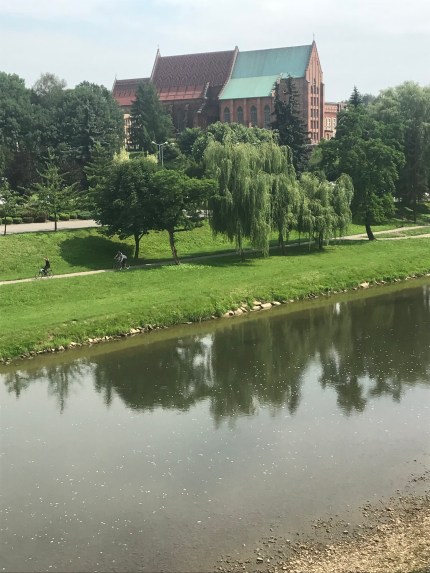
I pondered the pebbled indentations of crumbling sidewalks and graffiti scrawled on blackened apartment buildings near the train station. The sky diluted to a hazy blue and the summer heat intensified. I passed gas stations, supermarkets, traffic circles. A riverside park and towpath materialized as my thoughts wandered to shade. The road narrowed to cross the Sola River and I quickly recognized the bridge and the buildings on the opposite bank as the location Lanzmann had used to introduce Oswieçim in his film. During the war, the retreating Polish army destroyed it just before the arrival of the Nazis on September 3, 1939. Today, the church steeple still proclaims arrival in the old town while one of its soot-covered neighbors has been cleaned and converted into a Hampton Inn. I discovered Oswieçim’s latest iteration to be a tidy Galician town with a hint of global domestication courtesy of the Hilton family.
 Oswieçim, Poland
The road turned up hill as it led to the town center. My Lonely Planet guidebook indicated that a Jewish museum had been constructed on a nearby side street and I resolved to seek it out on my way back to the train station. For the moment, my mind remained fixed on the cemetery.
Strolling past bakeries, shops, and restaurants as the locals leisurely tended to their errands, the scars of genocide seemed to exist in another universe. Eight decades ago, however, the Nazi occupation and daily operation of the camps would have mitigated such a sharp contrast between each side of the town. Still, the continuity of everyday life in such close proximity to the epicenter of destruction revealed a hidden afterlife of genocide. The prosaic scenes I witnessed in Oswieçim were not an averted gaze but rather a partial reprieve from being Auschwitz.
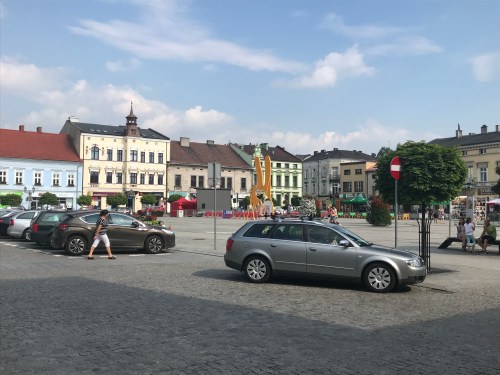 Oswieçim, Poland
The downtown faded as I continued along the road, which had expanded into a larger thoroughfare. Then, at an approaching street corner, I saw a large concrete wall lined with an iron fence on top. The wall wrapped around the corner; tall, leafy trees stood behind the enclosure. I had found Oswieçim’s Jewish cemetery. The entrance consisted of an archway filled by an iron gate with two doorways.
And both were locked.
My stomach tightened as I twisted the knobs fruitlessly.
I had come so far…
A sign next to the gate recounted the history of the cemetery in Polish and English. The site had been established in the late nineteenth century although Jewish burials in the area date to the late sixteenth century. The Yiddish name for Oswieçim is Oshpitzin. During the early modern period, Jews defied antisemitic settlement laws to establish a strong presence in the town, which eventually became known as a Jewish refuge in Galicia. In November 1939, the Nazis burned the town’s Great Synagogue to the ground. They shuttered the cemetery two years later as they began deporting Oshpitzin’s Jews to other ghettos before ultimately returning them to the camps on the other side of town. Out of a population of eight thousand, only a few hundred survived, many of whom migrated elsewhere after the war. In the 1980s, the Scharf family of New York funded the cemetery’s repair, which included the restoration of over eight-hundred tombstones, the reconstruction of the surrounding wall, and the installation of a protective iron gate. In addition to the presence of the Scharf family ohel in the cemetery, I wondered if the scene in Shoah might have provided some of the impetus for the restoration.
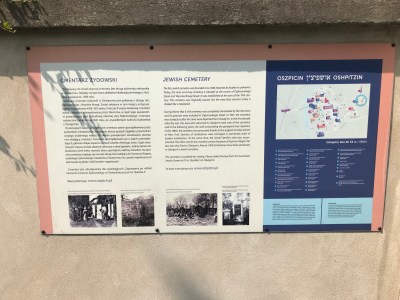 Outside the Jewish Cemetery, Oswieçim, Poland
The sign also indicated that a cemetery key could be retrieved at the Auschwitz Jewish Center. An address had been provided but I couldn’t look it up on my phone because I didn’t have an internet connection. I felt like a transatlantic sailor bobbing in a windless harbor, swatting at the dock with an oar.
To the chagrin of my sore feet, the best bet seemed to be retracing my steps for a kilometer and finding the Jewish museum. They would know. My guidebook and sketch of the town on Google Maps would help me find them.
Located on a side-street plaza near the bridge, Oswieçim’s Jewish museum opened in September 2000 under the direction of the Museum of Jewish Heritage in New York. The museum’s exhibits document the history of Oshpitzin and its Jewish community using artifacts and primary source materials. The site also includes a small, restored synagogue that serves as a place of prayer though it has no rabbi or congregation.
I played a brief game of charades with the Polish guard at the front desk before he fetched an English-speaking staff member from the museum café. As it turned out, I had come to the right place—this was the Auschwitz Jewish Center. After looking me over, the guard handed me a copper key on a chipped, plastic key chain. Energized and relieved, I shuffled back to the cemetery gate, periodically holding the key in my pocket.


Inside the Jewish Cemetery, Oswieçim, Poland
The door clanked open.
Silence enveloped me as I locked myself in. Just beyond the entrance, I sat on a concrete bench to gather myself. I looked back at the outside world ceaselessly unfolding on the other side of the gate. Seen from within the cemetery walls, the present appeared strangely timeless.
Yet what lay within seemed perpetually caught in time.
 The Jewish Cemetery, Oswieçim, Poland
To be sure, major improvements had been made since Lanzmann filmed here. Many tombstones have been identified and restored to their proper place. Commemorative plaques have been installed along the wall near the entrance. The cemetery is now physically protected, historically contextualized, and open to the public through limited, secure access. The history of Oshpitzin even has an app offering virtual tours of the museum and the town. So many meaningful steps have been taken to acknowledge and heal the past even as Oswieçim and Oshpitzin are inevitably overshadowed by Auschwitz. Traces of the multiple histories and identities tied to this singular place are conserved and publicly available, provided one is inclined to seek them out.
 The Jewish Cemetery, Oswieçim, Poland
The afterlife of genocide, however, also contains hidden purgatories. The Shoah was not only a concealed act of erasure against European Jews ensnared within the bounds of the Third Reich, it was also an attempt to erase that community’s past and its ability to know itself. The Nazis tore up the ancestral roots of Oshpitzin while rounding up its descendants for annihilation. The cemetery has since been restored but it is bereft of mourners. Auschwitz took those who could remember the forebears of Oshpitzin, thus condemning the dead to a second death. Broken tombstones remain, never to be fixed. Inscriptions fade. Grass overgrows. Painted numbers restore order while marking the wound and creating an unintentional sense of anonymity.
It is quiet inside the Oshpitzin cemetery. But there isn’t much rest.


 KURT MACMILLAN, PhD