

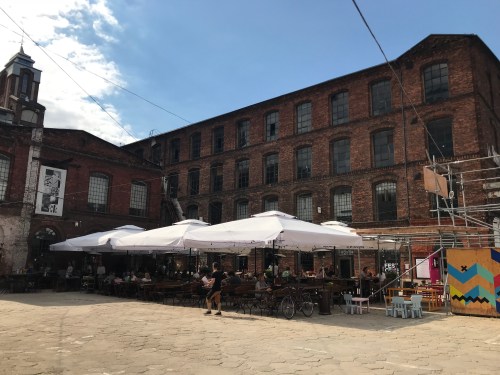
 The interior gate of Łódź’s Jewish Cemetery (above) and a restaurant near Piotrkowska Street (below).
On the morning of my fourth day in Kraków, I shared an unexpectedly convivial breakfast with my final set of roommates at the hostel—a pair of Belgian friends and a young woman from Russia—along with a middle-aged couple from Chile we met at the communal table.
It had been nearly a decade since I had last stayed in a hostel and during that interval an invasive species known as the Smartphone had erupted like an algal bloom. The balm of instantaneous contact with “home” had undercut the amiable mingling and spontaneous nights-out that had long been the upshot of shared living quarters. The hurdle of making contact “abroad,” it seemed, had become steeper as the risk of vulnerability in one’s own “foreignness” was now more easily avoided. Indeed, portable comfort zones could even expand imperiously to full-volume FaceTime calls in the lounge.
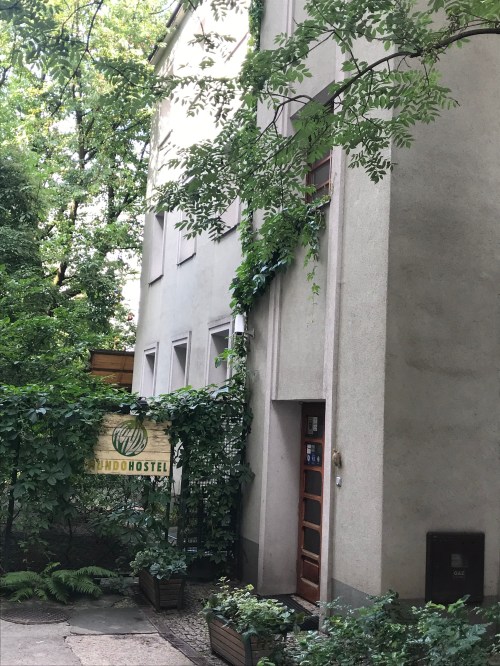 Mundo Hostel, Kraków – I launched this website there!
In the dining area, a selection of cheeses, meats, yogurt, fruit, and rolls had been spread around the table like distant rocks in a stream. The couple from Chile spoke quietly and prepared their plates with the faint hesitation of navigating the familiar in a new place. For reasons I cannot recall now—perhaps an inquisitive glance or the circulation of the butter dish—Spanish began volleying around the table with English trailing in its wake. The couple recounted their recent travels across Eastern Europe, the Belgians discussed the World Cup, and the Russian posed mischievous questions about the current U.S. president. For all its mundanity, the conversation was like curtains drawing back onto a luminous June morning. Upon reaching its conclusion, an untraceable hint of regret accompanied our leave-taking as everyone dispersed to new and unknown destinations.
My next stop would be Łódź.
Located about 140 miles northwest of Kraków, Łódź is a post-industrial city and the third largest metropolis in Poland (after Warsaw and Kraków), home to nearly three-quarters of a million people. In the nineteenth century, Łódź ballooned from a medieval village to an urban hub with the arrival of textile factories during the First Industrial Revolution. Łódź had also been a longstanding center of Jewish settlement, which accelerated during the city’s industrialization. Decades later under the Occupation, the Nazis renamed the city, “Litzmannstadt” and the northern slum of Bałuty became the site of the Jewish ghetto (alternately referred to as the Łódź or Litzmannstadt ghetto). The ghetto interned over 160,000 Jews from Łódź and the surrounding suburbs along with tens of thousands of deportees from other parts of Europe (Hilberg 225). Less than 900 people survived the ghetto to liberation by the Soviet Army in January 1945 (Wojalski 65).
 Street signs in Bałuty
My reasons for visiting Łódź were twofold.
First, it would serve as a home base for visiting the Chelmno death camp, forty miles northwest of the city with access largely limited to car. That journey is the subject of my next blog entry.
Second, I wanted to track down Łódź’s Jewish Cemetery, which surfaces briefly in Shoah during an interview with Paula Biren, a survivor of Auschwitz and the Łódź ghetto. Most recently, Biren was the subject of Bałuty, one of the chapters in Lanzmann’s final film, The Four Sisters, which focuses on her experiences in the ghetto as a teenager. Biren appears in Shoah after Simon Srebnik, a survivor of Chelmno, describes the disposal of victims’ ashes in the Ner River (see my previous blog entry). Biren’s refusal to return to Poland and her doubts about the postwar status of Łódź’s Jewish Cemetery, where her grandparents were buried, introduces a key theme of Lanzmann’s film: the relationship between Poles and Polish Jews. The subsequent camera shot of the present-day cemetery, fractured and desolate in wintery abandon, substantiates Biren’s misgivings. It also reveals Lanzmann’s shared skepticism and poses it to the viewer for consideration. Consequently, I had two questions for my visit to Łódź: What would I find if I visited the Jewish Cemetery today? And what might it tell us about the current status of Holocaust memory in Poland?
The bus from Kraków to Łódź set a meandering pace as its final destination was a long haul to Gdańsk on the Baltic coast. Along the way, we passed through Katowice (about 25 miles from Oswieçim), where Primo Levi spent time in a Soviet transit camp following his liberation from Auschwitz in January 1945. He recounts the experience in The Truce, a sequel to his famous Holocaust memoir, If This Is a Man (also known in English as Survival in Auschwitz). We also stopped in Częstochowa, home to a famous icon of the Virgin Mary known as the Black Madonna as well as the hometown of Abraham Bomba, a survivor of Treblinka and one of the most memorable interviewees in Shoah. A memorial stone for Częstochowa on the former site of the Treblinka camp shows up periodically in the film in association with Bomba’s testimony.
After several hours, we pulled off the main highway and began crawling through the traffic lights on Aleja Marszałka Józefa Piłsudskiego [Marshall Józef Piłsudski Avenue], one of Łódź’s main thoroughfares that bisects the city from east to west. It’s a wide boulevard lined with tram stops, shaded parks, and sprawling shopping centers. “Piłsudskiego” (as it’s known by shorthand) is named after Marshall Józef Piłsudski, a “founding father” of the Second Polish Republic, which governed the country during the interwar period from 1918 to 1939. Gazing at Piłsudskiego under an overcast mid-afternoon sky, my initial impression of Łódź was being off the tourist grid in an industrial city of no immediate charm. Compared to the sightseeing crowds grazing in Kraków’s Stare Miasto [Old Town], here, it seemed, the exigencies of everyday life set the pace.
 The Piotrkowska Centrum tram station at the intersection of Piłsudskiego and Piotrkowska in Łódź
Using the on-board Wifi, I noted the location of my Airbnb on a side street off Piłsudskiego as the bus wound its way to Łódź Fabryczna, the city’s newly renovated railway and bus station. As with my traverse across Oswieçim, I kept the map open on my phone since I would be unable to connect to the 3G network during my walk. With a rolling suitcase and messenger bag bouncing and scraping off street curbs and fragmented sidewalks, I probably should have opted for a cab. But when I arrive in a new place, I like to get bearings on foot. The location of my Airbnb turned out to be in a large apartment building without a call-box. Although I had my host’s phone number, my phone had no reception. I could message him but first I would need a Wifi connection. Usually, it’s available in cafes but being in a residential neighborhood, I would need an internet connection just to find one of those! Stumped and antsy, I paced the foyer, pondering the absurdity of being inside the building and unable to contact someone within it.
I knocked on the door of a radiology clinic in the first-floor storefront. After an exchange of confused looks and broken words, the man who answered the door directed me to an English language school two doors down. An enthusiastic instructor with sparkling English connected me to their Wifi network and the minor drama of connectivity limbo concluded moments later as a young man named Aleh showed me to an empty bedroom in the apartment he shared with his roommates.
 Piotrkowska Street, Łódź
After settling in and napping for a few hours into the late afternoon, I set off wandering through the city center. I took a tram back to Łódź Fabryczna, scouted a vegetarian restaurant near the station to save for later, and found my way to Piotrkowska Street, the main route through downtown. Lined with restaurants and shops in restored nineteenth-century buildings, Piotrkowska and the surrounding neighborhoods were a reflection of artistic and commercial life reanimating the industrial husks of nineteenth-century bourgeois society. Its clearest embodiment could be found several blocks away at Manufaktura, a sprawling, brick-laid textile factory that had been transformed into a shopping center with outdoor restaurants and international chain stores.
 Starbucks at Manufaktura, Łódź
The atmosphere of Łódź’s central district retained a discernible local flavor, perhaps aided in the hours of my exploration by soccer fans bursting into chants and waving Polish flags as they headed home after a disappointing loss to Senegal in the World Cup. Compared to Kraków’s tourist pomp and circumstance, Łódź seemed contentedly off-beat and under-the-radar.
The next morning, I slept in.
Still recovering from the long day at Oswieçim followed by the day-long relocation to Łódź, my mind wafted with undulating curtains and chirping birds as the morning sun slowly lost its tentativeness. My routine of getting cleaned up and practicing yoga unfolded at such a leisurely pace that Aleh felt compelled to check up on me by text. By late morning, I headed to the tram station across the street, negotiating one of Poland’s ubiquitous piekarnias (bakeries) along the way.
My destination was Łódź’s Jewish Cemetery in Bałuty. The trip required two tram rides and traversing a residential neighborhood with tree-lined streets and tall apartment blocks. As I moved along Bracka Street, my eyes traced the brick wall that marked the cemetery’s southern border.
 The cemetery gate near Bracka and Chryzantem, Łódź
At the intersection of Chryzantem, I saw a wide brick arch and a metallic green gate with Stars of David formed on it. I approached the gate and pushed.
Locked.
I groaned. Yet after my experience two days prior in Oswieçim, I had already become an experienced hand at finding my way around unexpected obstacles. Through Lonely Planet, I knew that Radegast Station, another site from the Litzmannstadt ghetto, was a few blocks away. Perhaps someone there would be able to help me.
Beyond my guidebook, landmarks of the Litzmannstadt ghetto had been clearly marked around the city. Streets located within its former boundaries acknowledged it on their signs and maps for self-guided walking tours through Bałuty had been posted around the neighborhood. Like the trail of Oshpitzin I found in Oswieçim, such efforts to preserve public memory appeared more commemorative than touristic.
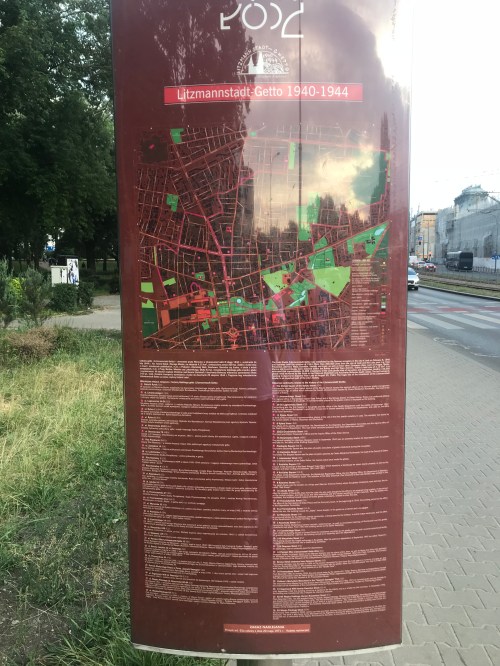 A sign for self-guided walking tours through the Litzmannstadt Ghetto. This sign was near Manufaktura, which is also located in Bałuty.
After crossing an expansive boulevard on the north end of the cemetery, I entered a vacant area of mangy grass and empty lots. A tall brick chimney attached to a cement complex stood at the end of the street. The words, “Thou Shalt Not Kill” had been printed in Hebrew, Polish, and English in metallic letters above its gated doorway, decorated with the Star of David. Along the cement wall, each year of the war from 1939 to 1945 had been inscribed on it. Rounding the corner, the street turned to cobblestone and an old wooden train station appeared.
 Radegast Station, Łódź
Located at the northeast corner of the Litzmannstadt ghetto, Radegast Station was the main transit point for prisoners arriving in Łódź from other parts of Europe and for the deportation of ghetto internees to Chelmno and Auschwitz-Birkenau. An inscription on a nearby wall noted that 43,000 Jews and 5,000 Roma passed through the station en route to the ghetto and 145,000 Jews from the ghetto had been sent to the death camps. The eastern wall bordering the station had been transformed into six large tombstones acknowledging the final destinations of deportees from Łódź. Memorial plaques from the cities of Łódź, Vienna, and Luxembourg paid tribute to their citizens who passed through Radegast. On the station platform stood a locomotive and three open cattle cars from the Reichsbahn (German National Railway). Compared to modern-day freight containers, these cars seemed shorter in height and more claustrophobic than one might otherwise imagine.
Circling the station building, I discovered a sign that accounted for the site’s emptiness—the museum and the deportee tunnel had been closed for renovations through November.
Foiled again.
Still, my hand reached for the station door and pulled.
Locked.
As I walked away, considering my next move to gain access to the cemetery, I heard the door swing open.
A late middle-aged Polish man who spoke English stepped outside and greeted me. He asked me where I was from and his eyes smiled when I said, “California.” He pointed me around the station grounds and gave me directions to the cemetery entrance. It turned out to be on Zmienna Street, which runs along the cemetery’s eastern end—the side I had not yet explored.
Finding the open gate was a welcome sight.
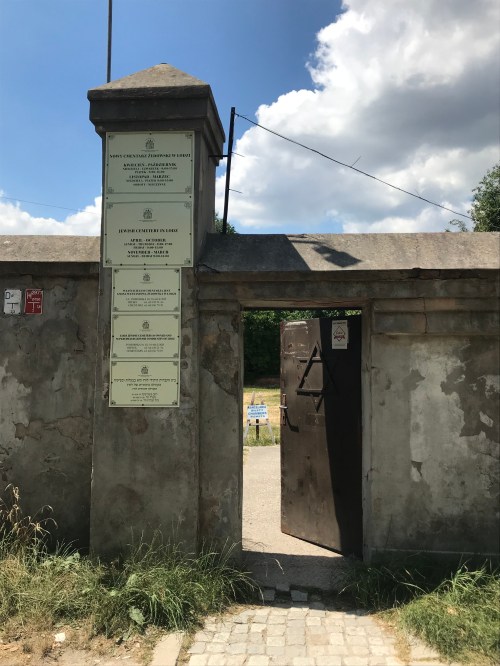 Entrance to Łódź’s Jewish Cemetery on Zmienna Street
Łódź’s Jewish cemetery is about 100 acres in size and is purported to be the largest of its kind in Europe (Wojalski 52, 58). A century ago it would have been known as the “New Cemetery” to the city’s long-time residents. It opened in 1892 to accommodate the exponential growth of Łódź’s Jewish population in the nineteenth century, a development that paralleled the city’s industrialization. While the “Old Cemetery,” which opened on Wesola Street in 1811, had an estimated 15,000 gravesites, the “New Cemetery” expanded to 180,000 (Wojalski 5, 14). On the eve of World War II, Łódź’s Jewish community was only second to Warsaw in size (Wojalski 65).
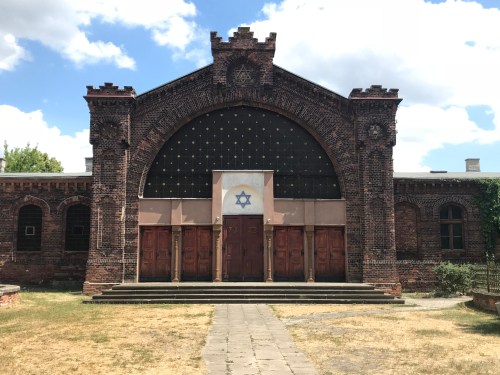 The Pre-Burial House in Łódź’s Jewish Cemetery
Upon entering the cemetery, I passed through the large pre-burial house used to prepare the deceased for internment, with separate areas for men and women. Currently, a small side room is used as an information desk where a small admission fee is collected to support the cemetery’s upkeep. A sign at the cemetery entrance underscores that the entire site is owned and maintained by Łódź’s Jewish community.
 Memorial plaques inside the cemetery’s interior wall
Beyond the pre-burial house, a second wall with a gate is situated inside the cemetery to delineate passage between the worlds of the living and the dead (Wojalski 52). The interior side of this wall has become a site for family memorial plaques honoring Holocaust victims from Łódź.
The northern end of the cemetery is mostly wooded and has roads and pathways leading past rows of mazzevah (headstones). Elaborate mausoleums distinguish leading families in the community prior to World War II. Many areas are overgrown with vines and weeds. Illegible tombstone inscriptions are not an infrequent sight. While Jewish tradition does not require gravesites to be maintained in pristine condition, signs of the afterlife of genocide are unmistakable.
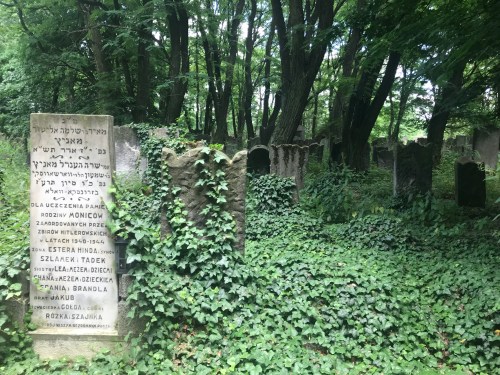 Łódź’s Jewish Cemetery
The scars of the Holocaust run even deeper in the southern end of the cemetery known as the ghetto field. During the Litzmannstadt period, it was a site of mass executions and mass graves. An estimated 43,000 people are buried here, largely in unmarked graves. It is the same place where Lanzmann filmed in response to Paula Biren’s report of rumors that the Poles would level off the cemetery. During my visit, I encountered no direct evidence to confirm or refute such a claim.
 Łódź’s Jewish Cemetery
I did see a tombstone from 1969 on the north side, suggesting continued use of the cemetery after the war. A booklet about the history of the cemetery indicated that preservation efforts commenced in the 1980s (Wojalski 24). A few signs posted in the ghetto field revealed that over the past few decades surviving family members and the Israeli army have played key roles in repairing the gravesites.
Yet even some of the restoration work seemed to have already fallen into neglect. A crew of workers circulated around the field with weed-whackers to expose the new grave markers hidden beneath the long-overgrown grass.

 The ghetto field in Łódź’s Jewish Cemetery
At times, disintegrating gravesites resembled unburied mummified remains rather than places of eternal rest.
I returned to the northern end of the cemetery and wandered through hidden corners, uncertain of what I sought. As I headed back to the interior gate, I met a family from Argentina—a middle-aged son and his two parents. Like at breakfast the previous morning in Kraków, I’m not sure how the conversation started and it included a mix of Spanish and English. The father was a survivor of the Łódź ghetto. I told them about my project on Shoah, a film they recognized.
“And are you Jewish?” the son asked matter-of-factly.
While I had occasionally pondered my stake in this work, I had yet to be called upon directly for a definitive answer—either by myself or by others. Over the years I’ve come to regard humanistic inquiry as a way of connecting with others, both real and figurative, through the pursuit of truth. If I want to discover something new about myself, I have yoga and meditation for that.
“No,” I replied with a hint of surprise.
“That’s good,” he said with satisfaction.
His words leaned on me like buttresses for a much-needed bridge.
Works Cited
Hilberg, Raul. The Destruction of the European Jews, 3rd ed. New Haven: Yale University Press, 2003.
Podgarbi, Bronislaw. Cmentarz Zydowski w Lodzi / The Jewish Cemetery in Łódź. Łódź: Wydawnictwo Artus, 1990.
Wojalski, Miroslaw Zbigniew. The Jewish Cemetery in Łódź. Łódź: Widzewska Oficyna Wydawnicza, 2001.

 KURT MACMILLAN, PhD