

I began my last full day in Poland sitting on the floor of Jacek’s apartment.
A sheepskin mat cushioned me on the parquet wood—a fleecy comfort I brought from California whose snowy whiskers were forever entangling themselves in my suitcase zipper each time I packed up for a new destination. The drowsy sunlight of early morning began to crystallize like the stamens of a waterlily reaching out from its wreath of petals. A crisp air wafted through the balcony doors, enveloping my quarters with a respite from late June. Legs crossed and one hand resting in the other, I cycled through a long series of breathing exercises while the soft undulations of a recorded mantra filled my ears.
Another long day lay ahead of me.
Soon I would wind down a hill to the bus station where I would hail a taxi to bring me to the city’s west end. The cab would traverse Wieniawa, a university neighborhood filled with lecture halls, scientific institutes, and student apartment blocks that seemed like a pocket of contemporary life far removed from Lublin’s Old Town and the Majdanek concentration camp—an impression that had been challenged by a photograph I’d seen the day before.
During my visit to Majdanek, I had perused a historical exhibition about Operation Reinhard, a cornerstone of the “Final Solution” that centered on the mass murder of Polish Jews at the extermination camps of Treblinka, Sobibór, and Bełżec. Lublin served as the main headquarters of Operation Reinhard and the exhibit included a photograph of the exact administrative building—a former gymnasium (secondary school) that has since become part of Lublin’s Catholic University on the edge of Wieniawa. Today, the hum of institutional routine is the neighborhood’s link to the past rather than a sign of its insularity.
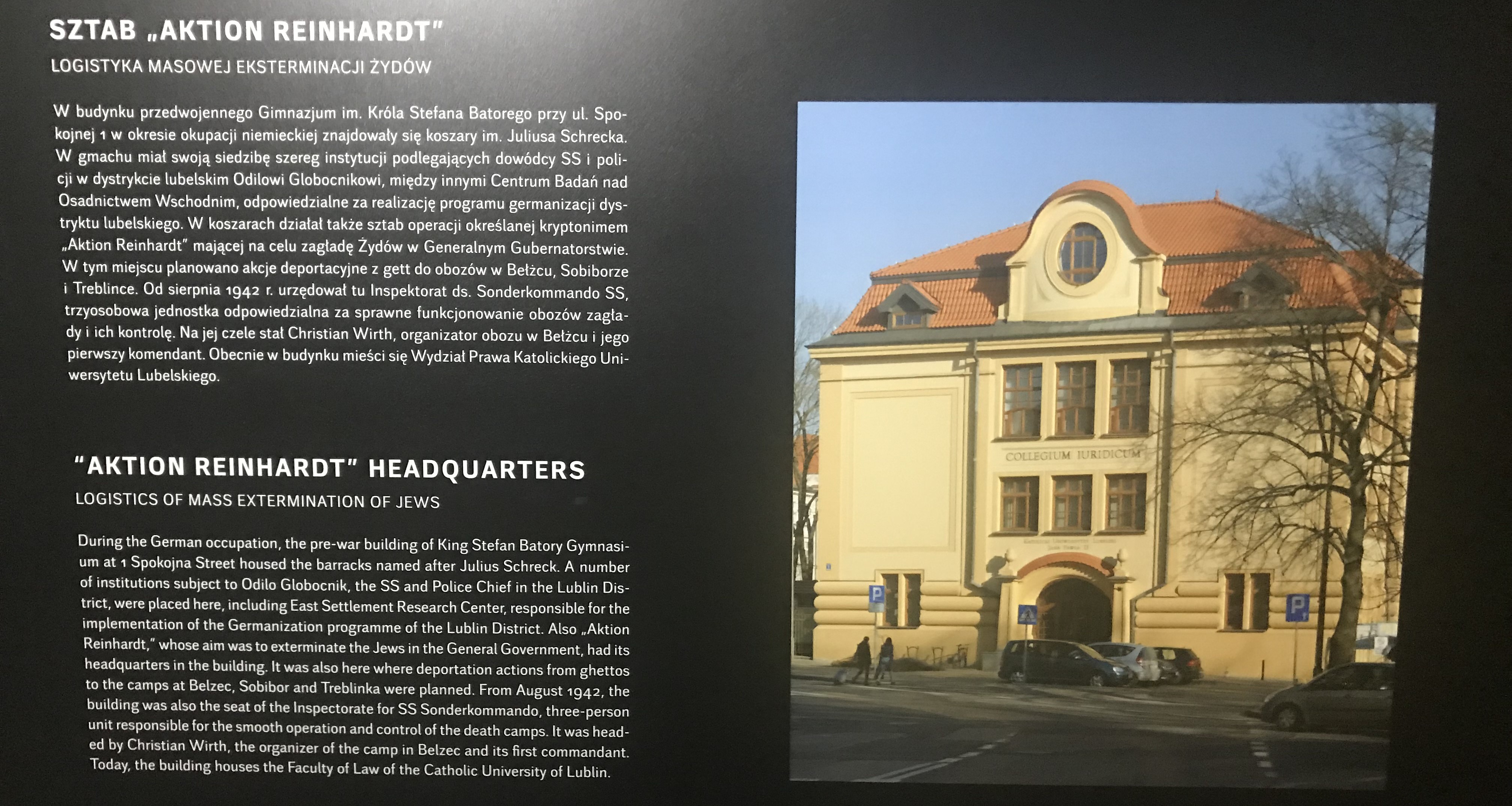
Along Wieniawa’s tree-canopied avenues, the tendrils of history would seem interwoven with the summer verdure. The taxi would deposit me in front of a Communist-era relic of a hotel that now contained an Avis desk, where I would I pick up a rental car that turned out to be no less than a maroon Volkswagen with a manual shift. I would attach my GPS to the windshield and set the coordinates for Bełżec, eighty-five miles southeast of Lublin and nine miles from the Ukrainian border.
But I had not embarked on that journey just yet.
Instead, I sat entwined in the same morning yoga routine that I had practiced for months. The very idea of writing a book about Claude Lanzmann’s film, Shoah, had dawned on me while completing the same meditative sequence three months earlier in California. Now, I found myself absorbed in the same breathing pattern, lulled by the same mantra, but perched on a floor in southeastern Poland near the end of a two-week trip around the country. As my breath descended to a slow tempo, my thoughts lingered on how quickly I had moved from the inception of an idea to the completion of its opening act. Once the notion of writing about Shoah had surfaced from a semi-conscious haze, I knew traveling to Poland would be one of my first steps.
Now approaching the end of that journey, I had come full circle as I drifted into a meditative state in Lublin. I felt tempted to cede all credit to my yoga practice for bringing me to this moment. But its main role was a catalyst—the origins of the Shoah project and my trip to Poland had much deeper roots.
* * *
For years, I have pursued closer contact with books, films, and histories that I’ve found especially compelling. Fictitious works rooted in real places often spur my curiosity in seeing them firsthand and in some cases I have traveled to locations that a favorite writer or filmmaker incorporated into their work. While there is a “fandom” component to these journeys, their underlying attraction for me is mystical. When a real place becomes part of a fiction, it seems to be granted a second life, taking on another order of existence beyond its everyday appearance. The details of the dual lives of such places fascinate me. Never entirely here nor there, they represent an interface between the material world and the metaphysical realm of human creativity.
Stepping into such in-between places is not always a light undertaking. What might appear to be an amusing diversion can sometimes yield unnerving insight. Some years ago, Hitchcock’s Vertigo worked its way into my travel itinerary in San Francisco. As the film’s main setting, Hitchcock made extensive use of famous city landmarks to lend his work an iconic air. After adding a few sites to my “to do” list, I soon found myself ambling by the Palace of Fine Arts and glancing up at the Golden Gate Bridge from Fort Point in half-conscious imitation of Scottie, the film’s protagonist played by Jimmy Stewart. In the early scenes of Vertigo, the audience follows Scottie as he shadows Madeline, the wife of an old friend, as she wanders the city. Madeline appears to pursue, and possibly be possessed by the spirit of Carlotta Valdes, a long-deceased ancestor who committed suicide after being cast aside as the mistress of a wealthy man. Against the backdrop of San Francisco landmarks, the audience is drawn into a hypnotic spiral as it follows Scottie following Madeline following Carlotta.
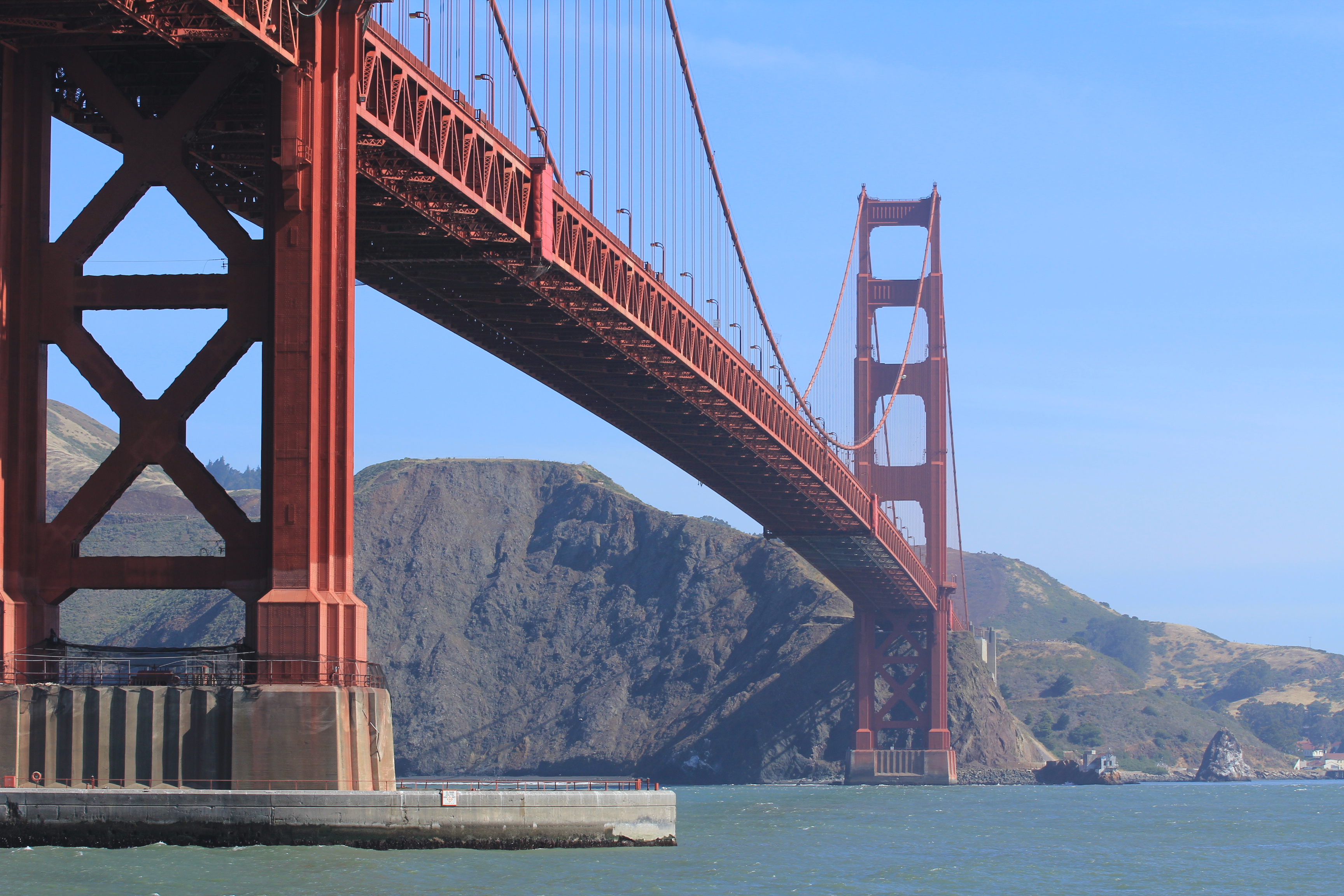
Scottie’s investigative shadowing imbues the city with the enigma of Madeline, in which the lines between past and present, fact and fiction, and self and other are blurred to threatening and captivating effect. By incorporating San Francisco landmarks into the mise-en-scène, Hitchcock not only staged Vertigo’s psychological conflicts but wove them into the fabric of the city itself, fraying the presumed edge between cinematic fiction and everyday reality in the process. Seeking out a few of these sites on my own was less about Hitchcock becoming my tour guide than falling further under the spell of Vertigo—a film about falling under spells that simultaneously instills that experience in the audience. Paradoxically, stepping out of the movie theater and onto the streets of San Francisco to uncover the reality behind the image was the ultimate sign that I remained mesmerized by Vertigo’s chimeras, that the film was still playing me.
Not all of my journeys, however, have been so abstract in their intentions or teasing in their results. In contrast to fictitious works, my pursuit of historical sites is often tied to the classroom.
Just before I discovered the Shoah project, I had visited Crescenta Valley Community Regional Park near Glendale, California to see the results of a recent historical controversy that I had been teaching my students. The dispute centered on new sign that had been installed at the park entrance by the LA County Parks and Recreation Department in 2016, which read, “Wilkommen zum / Welcome to Hindenburg Park.” The sign had been donated by the Tricentennial Foundation, a local organization seeking to commemorate the park’s history as a hub of German-American culture in Southern California.
From the 1920s through the 1950s, a portion of the land that now belongs to Crescenta Valley Park had been privately owned by the German-American League, a community group that sponsored cultural activities around the greater Los Angeles area including an annual Oktoberfest. In 1934, the League named their recreation area “Hindenburg Park” in honor of former German president Paul von Hindenburg who had died earlier that year. With the onset of World War II, the League renamed the park to the more benign, “La Crescenta Picnic Grounds” although the “Hindenburg Park” nickname persisted for years. In the 1950s, LA County acquired the land and incorporated it into the neighboring Crescenta Valley Park. More recently, the Tricentennial Foundation sought to recognize and preserve the memory of “Hindenburg Park” by presenting county officials with the welcome marker.
In response to the sign’s installation, area residents (including fellow German-Americans), historians, and the Jewish Federation of Greater San Gabriel and Pomona Valley criticized the sign as an honorific for President Hindenburg and a one-sided acknowledgment of the park’s history. Hindenburg, they reminded, had a big hand in engineering the antisemitic “stab-in-the-back” myth that scapegoated German Jews for the country’s loss of World War I, which had a profound impact on postwar German society and Adolf Hitler, whom he would later appoint as Chancellor. The “Hindenburg Park” sign, they argued, perpetuated the honoring of Hindenburg while ignoring his historical record.
“Hindenburg Park” had also been the site of pro-Nazi rallies and propaganda campaigns in the 1930s, including a youth camp modeled on the Hitler Youth. Such activities had been devised by the German-American Bund, a pro-Nazi movement in the US sponsored by the Third Reich that managed to penetrate the German-American League in Southern California. “Hindenburg Park” was in fact one of many sites of attempted Nazi subversion in the greater Los Angeles region.[1] Cal State Northridge maintains an archive of Bund artifacts and propaganda, including photographs and flyers from “Hindenburg Park” and an online exhibition. The new sign represented selective memory, according to opponents, rather than a complete picture of the park’s history.
About a year and a half after the controversy erupted, the LA County Parks and Recreation Department brokered a settlement: the welcome sign donated by the Tricentennial Foundation would be taken down and replaced by a small historical exhibit showing different sides of the park’s history. When I learned of its installation, I decided to track it down and see what information it contained.
“Can I come with?” volleyed a student from the back of the classroom when I announced my intention to visit the park that weekend and share the results on Monday. While I demurred at the suggestion of a carpool or an unofficial class trip, I appreciated their amiable curiosity in the cliffhanger I’d presented to them.
The next morning, I had a hard time finding the new exhibit. I did recognize the former location of the “welcome” sign but found no further clues to direct me. Weekenders reclining in lawn chairs gave me puzzled looks when I asked them for help. Perhaps the exhibit had been vandalized and taken down for repairs, I thought, but that would have made the local news. On the verge of giving up while groaning at the prospect of returning to my students empty-handed, I ventured deeper into the interior of the park. There, I stumbled upon it almost by accident at the edge of a field.

Compared to the entrance sign donated by the Tricentennial Foundation, the historical exhibit was a decidedly low-key affair. Easily overlooked instead of hard-to-miss, from a distance it resembled an interpretive nature sign. The exhibit had been framed as “German-American History at Crescenta Valley Community Regional Park” and a map of the former grounds of “Hindenburg Park” occupied the center of the panel. It appeared that the sign’s location had been chosen to allow viewers to imagine the former landmarks of “Hindenburg Park” within the contemporary landscape.

Each “side” in the controversy had three columns of text and archival images to highlight their perspective on the park’s history with the map serving as a demarcation line. The left side emphasized cultural festivities and German-American service in the U.S. armed forces during World War II while the right side revealed Nazi activities and the promotion of Hitler’s racial ideology in the park. A concluding statement called for vigilance to safeguard “American ideals of justice and equal opportunity” while appreciating a “lovely place that today is a park for all.”
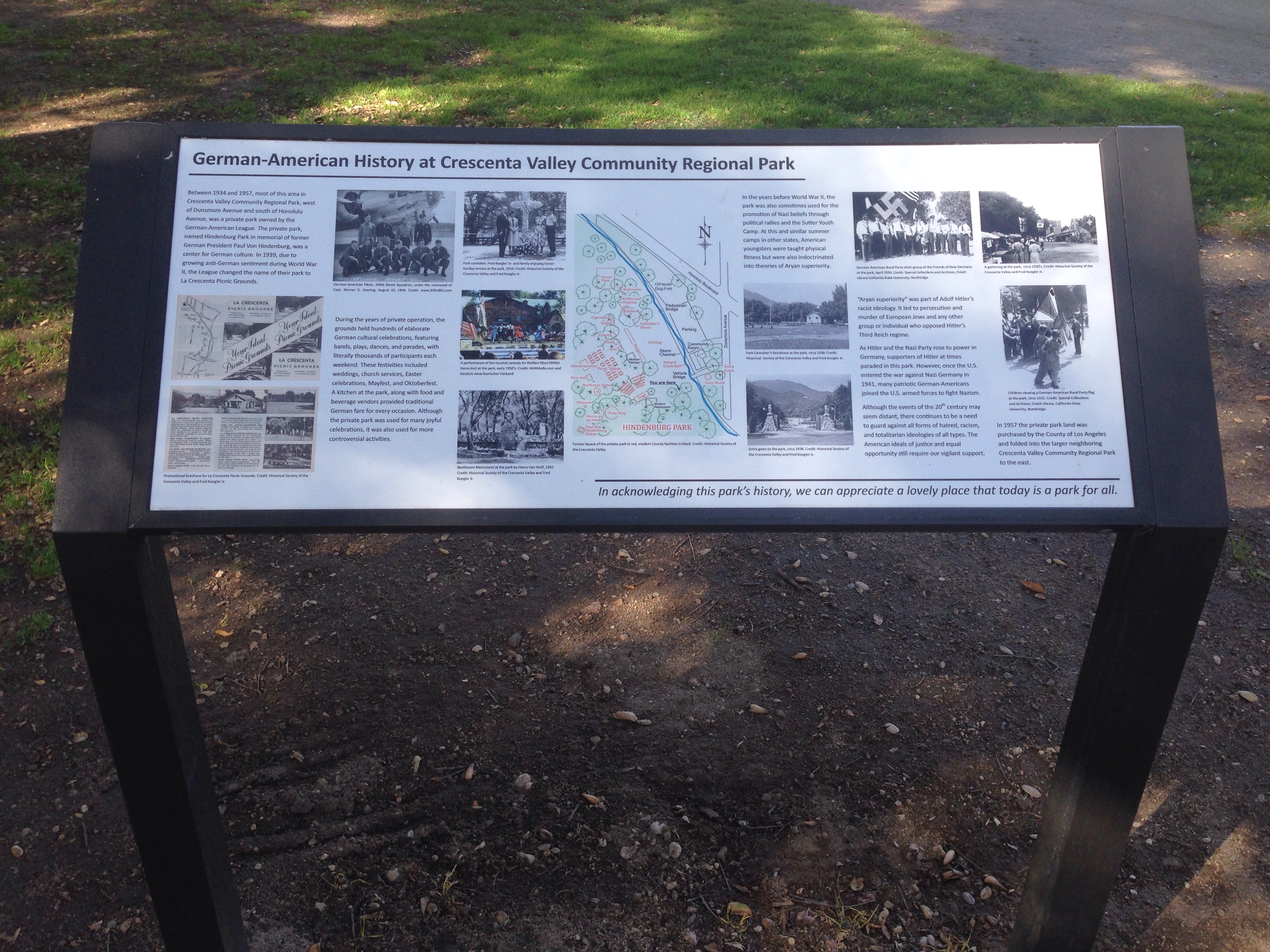
When I shared photos of the exhibit with my students the following week, their reactions pivoted on the difficulty I had finding it. Having already learned about the Bund movement, which they found very unsettling, they expected the exhibit to have a similar stature to the welcome sign. While recognizing the differences between historical and monumental displays, they thought the exhibit would have taken up a bigger footprint in the park. Shouldn’t a message of vigilance be given due prominence instead of being left to chance encounters?
Meanwhile, I drew their attention to the fact that the exhibit mentioned President Hindenburg as the park’s namesake but did not discuss his connection to antisemitism and the rise of Adolf Hitler. Placing Hindenburg in historical context might have exposed county officials to criticism and embarrassment for originally accepting and displaying the welcome sign. It also would have muddied the “positive” account of the park’s history and undermined the “two sides” approach to settling the controversy.
Here, I am reminded of an artifact from the Cal State Northridge archive that I had previously shared with my students: a flyer for a May Day Festival at the park in 1939 slated as a “Giant Pro-American Rally” that in addition to music, food, and folk dances included speakers from the German-American Bund who would, “Expose the Real Enemies of Our United States of America.” Or as I usually quip to students, “Come for the food, stay for the propaganda.” By attempting to give equal voice to the two different constituencies in the welcome sign controversy, the exhibit oversimplifies the park’s history by framing it as pro versus con. The flyer, however, reveals a murkier historical reality, one that is rooted in the entanglement of the “two sides” rather than their neat separation. A larger exhibition with a bigger footprint would be needed to really examine the park’s history beyond the sign debate binary.
Refining public memory toward greater sophistication and justice not only informs my approach to the “Hindenburg Park” controversy and my work as a history teacher but it’s also what draws me to an expansive and nuanced work like Shoah.
* * *
Perhaps the most fertile soil for the Shoah project’s genesis came from the classroom, where I have been smuggling bits of the film into my lesson plans for years. Excerpts from Lanzmann’s work have briefly illuminated the darkened lecture halls of world and U.S. history surveys and flickered across projector screens in writing courses and honors seminars about gender and ethnicity. Shoah’s density lends it versatility as a pedagogical device—from introducing students to lesser-known aspects of Holocaust history to analyzing cinematic technique and interpreting survivor testimonies. Still, the film’s nine-and-a-half hour running time and the intricate context of any given scene might seem like insuperable barriers to everyday classroom use. Bringing Shoah to undergraduates has placed me in the role of a secondary film editor who parses excerpts that can be introduced, viewed, and discussed within the allotted class time. Adapting course curricula to include the film while tailoring the film to fit the logistics of a class meeting has been a challenging but rewarding enterprise.
On “Shoah Days,” a slight flutter will arise in my stomach as the students take their seats and I unpack the DVD box set at the lecture podium. In contrast to my other lesson plans, presenting Shoah feels more personal and exposed. By carving an unexpected path from the course curriculum to specific moments in Lanzmann’s film, my own zeal is on display. A palpable stillness envelops the room as the film’s subdued pace and muted aesthetic centers their attention on each voice, sound, and image on screen. When the classroom lights are turned back on, an introspective silence is followed by small group conversations and then a full class discussion.
Lanzmann’s film is an unusual and demanding viewing experience, one that is oriented towards reading between the lines rather than following a trail of emotional cues. His work calls for the spectator to see beneath the surface of what appears on screen while adapting to non-linear and elusively thematic narrative threads. For students, the lack of familiar landmarks and the foiling of their expectations can be especially challenging.
I learned to teach Shoah in part through trial-and-error by dropping students into its filmic river, seeing where they ended up, and reeling them back in. I often noticed them seeking conventional emotional cues from a movie that omits them on purpose. Sensing a gap or tension in being left to their own devices, some students looked for emotional signals from the figures on screen to orient their own feelings, often misreading the film and those figures in the process.
Here, I am reminded of a fleeting moment in graduate school when I worked as a teaching assistant for a World War II history class. I had decided to show clips from Shoah in my breakout sections one week to generate discussion and supplement the professor’s lectures on the Holocaust. I began with the film’s unforgettable opening sequence of Simon Srebnik, a survivor of Chełmno, returning with Lanzmann to the former site of the extermination camp and its environs (see #11). These elaborate scenes, which center on the unfolding of Srebnik’s memory, are followed by a brief counterpoint drawn from Lanzmann’s interview with Michael Podchlebnik, another survivor of Chełmno. While Srebnik revisits and “reenacts” elements of the past in situ, Podchlebnik, speaking at home in Israel, prefers to keep his distance. During this brief segment, Podchlebnik often smiles, which prompted a prolonged beam in return from one of my students,
This exchange of smiles surprised me.
Podchlebnik’s demeanor in this scene had always struck me as nervous and vulnerable, his incongruous smile teetering on the verge of tears at the prospect of sharing memories of Chełmno. The occasional brightness that would sweep over his face seemed to belie an underlying weariness. Seeing him hover at the brink of an inexpressible past, my feet would roll onto their sides.
Perhaps the student felt uneasy, too. Podchlebnik’s smile might have been a welcome sight after watching Srebnik retrace the edge of a mass grave at Chełmno. But it was not a lifeline nor a beacon of grandfatherly warmth but something more akin to a shield. By taking Podchlebnik’s smile at face value, the student might have found a reprieve from the larger exhumation of the past unfolding on screen. Ironically, a protective veneer could become a point of emotional identification.
Lanzmann, however, remembers Podchlebnik’s smile differently.
In his memoir, The Patagonian Hare (published in French in 2009 and in English in 2012), Lanzmann distinguishes it as “courageous” and characterizes Podchlebnik as “heroic and rigorous.”[2] His countenance made such a profound impression on Lanzmann that he declares it the “face of the Shoah.”[3] And when Podchlebnik dissolves into tears in a later scene, Lanzmann says that he also cries when he re-watches it and recalls pressing his hand on Podchlebnik’s shoulder to “help him find a voice.”[4]

Discovering this passage in the memoir also elicited my surprise. Had I missed some subtle cue in this scene all along? Or was Lanzmann taking a revisionist stance on his work in response to perennial criticism for being too pushy with his interviewees? In the scene viewed by the students, for example, he asks Podchlebnik why he smiles all the time, which sounds like a provocation rather than an appreciation.
The answers to both questions are “no.”
To understand why, we must situate the Podchlebnik scene in relation to the ones that directly precede and succeed it and examine the original, full-length interview available through the US Holocaust Memorial Museum’s online collection of Shoah outtakes.
First, it is important to recognize that Shoah is not a long series of standalone moments with different interviewees; rather, it is a mosaic composed of carefully selected fragments arranged in thematic patterns. Adjacent segments of the film are interwoven by subtle contiguities and overlapping subject matter while larger sections of the film contain underlying motifs. As a result, the meaning and purpose of any given scene is wrapped up in the adjoining scenes, which requires more than a close reading of individual segments to recognize.
The scene concerning Podchlebnik’s smile and his relationship to the past is preceded by Simon Srebnik’s return to Chełmno. The contrast in how they interact with the past—the former at home and reluctant to speak and the latter returning to Poland and reenacting key moments—helps mediate audience expectations about survivor memory from an early point in the film. Some figures may speak more openly than others, demeanors will vary from one person and one moment to the next, and all are carrying immeasurable burdens that resist articulation. The immersive opening sequence with Srebnik is tempered by Podchlebnik’s reticence, a polarity that introduces the viewer to the spectrum of on-screen remembrances from Holocaust survivors in the film.
The discussion of Podchlebnik’s smile is followed by a short clip of Hanna Zaïdel, the daughter of Motke Zaïdel, a survivor of the Ponary Forest massacres near Vilna, Lithuania. Her brief appearance in Shoah is culled from a longer interview that Lanzmann conducted in Israel with her father and Itzak Dugin, another survivor of Vilna; one part of the interview occurred at Motke Zaïdel’s apartment surrounded by family (including Hanna) while the other part unfolded at the Ben Shemen Forest to approximate Ponary. In Shoah, Ms. Zaïdel sits behind her father in the family living room and explains her interest in hearing his story:
[H]e was a silent man, he didn’t talk to me. And when I grew up and was strong enough to face him, I questioned him. I never stopped questioning him, until I got at the scraps of truth he couldn’t tell me. It came out haltingly. I had to tear the details out of him, and finally, when Mr. Lanzmann came, I heard the whole story for the second time.[5]
As she speaks, the camera pans to the left and rests on a close-up of her father’s stoic face.
As the child of a survivor, Ms. Zaïdel alludes to the strain of being raised in the shadow of the Holocaust. Her father’s silence about the past might have served as a strategy of self-preservation and family protection but it also entailed distance and disconnection. For Ms. Zaïdel, her father had long appeared mysterious, unapproachable and requiring enormous strength and persistence to confront. Even if the past had not been openly discussed in their family, it had always been present through his silent figure.
Lanzmann’s inclusion of Ms. Zaïdel’s statement early in the film plays several roles. First, it acknowledges that Shoah is in part a film for the children of survivors as well as younger and future generations. Her tenacity expresses a commitment to not only to understand her father better but also to unearth the truth about the Holocaust—an undertaking, she acknowledges, Lanzmann helped to advance. At the same time, the relentlessness she attributes to herself provides context for Lanzmann’s own persistent questioning of guarded figures such as Podchlebnik and her father. Through her statement, Lanzmann telegraphs his own role as interviewer in the film, likening it to a resolute and occasionally vexing family member who hounds the truth and does not easily give up.
Situating Podchlebnik’s smile in relation to the adjacent scenes with Simon Srebnik and Hanna Zaïdel reveals that the struggle to conjure and transmit memory is an active dynamic in Shoah rather than a rough edge smoothed over in the editing process. The sense of exposure present in the film, in turn, implicates the audience, who must navigate the rawness and tension of what unfolds on screen without emotional cues and scaffolding to lean on. This challenge is integral to the experience of watching Shoah, especially for the first time, as symptomatized by the student who burrowed into Podchlebnik’s smile for emotional grounding. Mitigating the sense of exposure generated by the film is an unlikely belated move by Lanzmann. His inclusion of Podchlebnik’s smile is purposeful and multivalent and as a director he is not known for hedging his bets.
Lanzmann’s remarks in The Patagonian about Podchlebnik’s courageousness are best understood in relation to the original interview. A digitized version of their exchange in May 1979 is available online through the United States Holocaust Memorial Museum, which purchased the outtakes of the film (totaling 220 hours) from Lanzmann in 1996 and gradually posted them on their institutional website (under the “Claude Lanzmann Shoah Collection”) beginning in 2015.[6]
The outtakes reveal that Lanzmann’s interview with Podchlebnik followed a traditional, chronological account of his life—from sketches of his prewar life in Koło (about eight miles from Chełmno) to the details of his escape from the camp and the years of hiding that ensued. During this wide-ranging discussion, Podchlebnik appears more composed than he does in Shoah, his frequent smile signaling more affability than nervousness. Perhaps even more surprising is the discovery that the discussion of avoiding the past happened near the end of the interview rather than the beginning. While it appears in Shoah as a prelude to broaching the past, in the original interview it was an epilogue for having done so. Upon further reflection, however, it makes sense that Lanzmann started the interview by simply asking Podchlebnik his age and saved inquiring about his relationship with the past until much of it had already been disclosed. The apparent discrepancy in this case is really an illustration of how Lanzmann incorporated elements from a relatively conventional interview into an artistic work that follows a different set of imperatives.
The outtakes, it should be noted, are not a gargantuan “director’s cut” of Shoah nor is Shoah a highlights reel of the outtakes. Even though they are cut from the same celluloid cloth, the relationship between them is one of discontinuity. Michael Podchlebnik is different in the outtakes than he is in the film. The same can be said of Lanzmann. The artistic process fashions the materials it employs into something new, including the artist who casts himself in his own work. As a result, it might be no surprise that Lanzmann’s recollection of Podchlebnik does not perfectly align with the figure appearing in the film. Indeed, Lanzmann’s brief sketch of him in The Patagonian Hare combines pieces of Shoah, the outtakes, and his own memories of their encounter.
The outtakes of the interview with Michael Podchlebnik do contain some of the tenderness that Lanzmann alludes to in the memoir. He often appears in the camera frame seated near Podchlebnik, occasionally resting his hand on his shoulder at difficult junctures. Eye contact and physical touch are the most direct sources of connection between them since they are separated by a language barrier. Podchlebnik speaks in Yiddish during the interview and his exchanges with Lanzmann are mediated by Fanny Apfelbaum, a translator who sits off-camera. Lanzmann often poses his questions to Apfelbaum instead of directly to Podchlebnik (e.g. “What died in him in Chełmno?”), and she responds by speaking for the interviewee in the third person (e.g. “Everything died. But he’s only human and he wants to live”), which adds a slight stiltedness to the interview. These complications might explain why Lanzmann’s memory of Podchlebnik emphasizes the physical—the face, the smile, the tears, “my hand pressing on his shoulder,” “heroic and vigorous.”[7] Body language, gesture, and touch, with their attendant possibilities and ambiguities, assumed heightened importance under such conditions of verbal separation. Through his smile, Podchlebnik both acknowledged Lanzmann and continued to elude him.
Incongruous smiles—from a figure in Shoah and a student watching the film—provoke interpretive work. Indeed, that is the intended effect of a film that does not signpost meaning. According to Lanzmann, “Le film est fait…pour que les gens continuent à travailler. Pendant le déroulement de la projection, mais aussi après.” [The film is made…so that people continue to work. During the screening but also afterwards.][8] Embracing that work in its full complexity has made me a better teacher and interpreter of Shoah—undertakings I discovered through a concurrent journey of meandering, experimentation, and self-observation.

[1] See Arnie Bernstein, Swastika Nation: Fritz Kuhn and the Rise and Fall of the German-American Bund (New York: St. Martin’s, 2013); Bradley W. Hart, Hitler’s American Friends: The Third Reich’s Supporters in the United States (New York: Thomas Dunn, 2018); Bernhard Rohrbacher, “‘Mit Deutschem Gruss’: On the History of Hindenburg Park in La Crescenta and the German American League of Los Angeles,” California History 95, no. 1 (2018): 25-53; Steven J. Ross, Hitler in Los Angeles: How Jews Foiled Nazi Plots Against Hollywood and America (New York: Bloomsbury, 2017).
[2] Claude Lanzmann, The Patagonian Hare, trans. Frank Wynne (New York: Farrar, Straus and Giroux, 2012), 436-437.
[3] Lanzmann, 436.
[4] Lanzmann, 436.
[5] Shoah, directed by Claude Lanzmann (1985: Criterion Collection, 2013), Disc 1, 14:55-15:27, DVD.
[6] Lindsay Zarwell and Leslie Swift, “A History of the Claude Lanzmann Shoah Collection at the United States Holocaust Memorial Museum” in The Construction of Testimony: Claude Lanzmann’s Shoah and Its Outtakes, ed. Erin McGlothlin, Brad Prager, and Markus Zisselsberger (Detroit: Wayne State, 2020), 50.
[7] Lanzmann, 436-37.
[8] “Le lieu et la parole” in Au sujet de Shoah: le film de Claude Lanzmann (Paris: Belin, 1990), 425. The English translation of the quote is my own.

 KURT MACMILLAN, PhD