#6 – AUSCHWITZ-BIRKENAU (PART II) – A PHOTO ESSAY

This slideshow requires JavaScript.

During my initial moments in the Auschwitz I camp, I felt confronted by the alterity of the past. As I retraced the steps of Lanzmann’s movie camera around the gas chamber and the crematorium, the words of Filip Müller echoing in my thoughts, an eerie, uncanny sense of familiarity flickered in my mind, like the furtive emanations of a signal lamp in the middle of a vast, dark sea.
The subtle combination of technology, artistry, and testimony in Shoah provides distant, fleeting glimpses into the void. Such flashes in the abyss might only further remind us of its unfathomable dimensions and the utter limitation of our knowledge. Still, they reveal landmarks: the specificity of “history” and “place” is partly (and powerfully) revealed through the details of individual memory. Most of the “tour guides” I would have liked to hear are long gone. Lanzmann’s work, in this sense, is indispensable. I wondered, too, if I should have brushed up on Primo Levi before my trip, perhaps carrying around a dog-eared copy of If This Is a Man with place-names highlighted as I navigated the camp blocks.
With the revelations of the past appearing most firmly rooted in the page, the screen, and the voice of the witness, I found myself at Auschwitz largely left to my own devices. I became, like many visitors who gaze at its ruins, a surveyor. This was my first visit to a place where I intended to build a kind of relationship

This slideshow requires JavaScript.

Blocks 14, 15, 16, 18, and 20 contained large historical exhibits from various European nations tied to the camp. Deeply engaging any one of them as an independent visitor would be a significant undertaking; with a guided tour, it’s virtually impossible. For the moment, I bracketed these displays as sites of national memory. For some, the titles were hegemonic claims:
Russia / Former Soviet Union: “Tragedy, Courage, Liberation”
Poland: “The Struggle and Martyrdom of the Polish Nation, 1939-1945”
Indeed, the Polish exhibit emphasized Nazi war crimes in graphic detail. In Block 6, the corridors were lined with photographs of Polish POWs who died in the camp. I overheard a tour guide note that the Nazis did not take pictures of Jewish prisoners. However, the implication that some of the faces on the wall were fearsome kapos (squad leaders) incentivized to brutalize the Jews remained unattended.
In contrast, the French exhibit underscored national guilt for collaboration.  French deportees to Auschwitz appeared as disconcerting, immobile shadows painted on the walls. In a similar manner to the Shoah museum in Paris, the display culminated in a room full of photographs depicting French Jewish children who perished at Auschwitz.

This slideshow requires JavaScript.

I also found occasional traces of Shoah. The French exhibit made explicit reference to the film while an installation on prisoner resistance contained a photograph of Rudolf Vrba, a key interviewee. It also included a memo written by Jan Ciechanowski, the Polish ambassador to the U.S., who observed the 1943 meeting between President Roosevelt and Jan Karski, which Lanzmann explored in The Karski Report.
The museum bookstore had a collection of important works in English, including Filip Müller’s testimony, Eyewitness Auschwitz: Three Years in the Gas Chambers. Books were the only camp-related “souvenirs” available.
IMG_4093

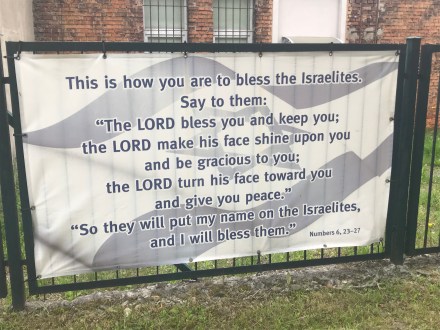
After a few hours of stock-taking, I exited the camp and ate lunch at a snack bar near the parking lot. A shuttle bus for Auschwitz II-Birkenau made its rounds as I refueled on carbs and sugar. Once again, I opted to walk as an opportunity to regroup and gather my thoughts. Along the two-mile walk from Auschwitz I to Birkenau, I passed the sign above and wondered who it was for exactly. And why was it written in English as opposed, to say, Polish? It implied a resolution to anti-Semitism in the Old Testament. And it appeared to be addressed to tourists rather than locals. Why? As a sign of Polish atonement? Or as a lesson from Israel as indicated by the flag?
IMG_4101
While Auschwitz opened in June 1940 on the site of Polish army barracks, the significantly larger Birkenau camp was established over a year later with the clearing of the nearby village of Brzezinka. Birkenau alone was the largest and most destructive of the Nazi concentration camps. While the blocks of Auschwitz felt tightly ordered and compacted, the skeletal remains of Birkenau seemed to extend endlessly in all directions. I felt as if most of my hometown in New Jersey, only a mile square, could fit within its gates. The sheer scale of the Holocaust resonated deeply as I traversed Birkenau’s gnarled remains.

This slideshow requires JavaScript.

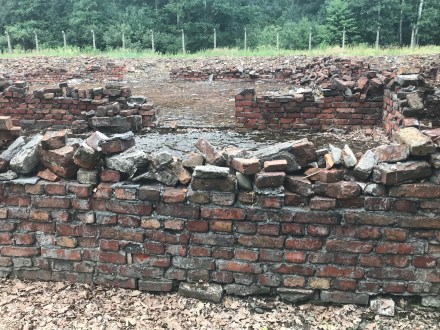
The remains of gas chambers and crematoria II and III, destroyed by the Nazis as the Soviet army approached.

This slideshow requires JavaScript.

Preservation work in the ruins of an undressing room.  In Shoah, the camera wanders down into it as Müller narrates the ordeal facing new arrivals.
Left: The Monument to the Victims dedicated in 1967.  Right: An impromptu memorial.
IMG_4140

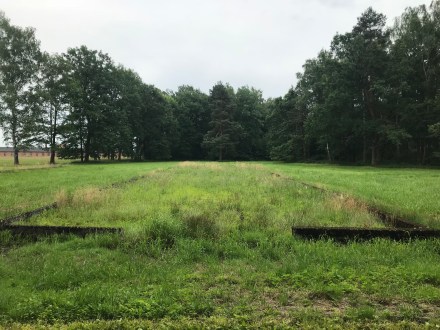
The remains of an undressing barrack.
I wandered the grounds of Birkenau for two hours, examining the major sites and diverting into less visited corners. At one point, I found myself at the edge of the camp in a field where human ashes had been disposed. On the other side of the gate, an old man slowly rode by on a bicycle as he held a shopping bag to the handle bars. We gazed at each other and exchanged a gesture of acknowledgment. “Who are you? And why are you here?” Two questions that both of our minds might have entertained simultaneously. One of the strangest and most disturbing aspects of visiting many of the camps in Poland was how daily life seemed to carry on just beyond the barbed wire fence, now as it did then.
Towards the end of my visit, I re-encountered the same group of Spanish-speaking high school students I had seen earlier that morning just outside the gate of Auschwitz I. Now, they were visiting a site in Birkenau where the Sonderkommando (Jewish special work detail) had heroically and hopelessly revolted in October 1944. As they stood looking at the remains of a crematorium damaged by the Sonderkommando, their attention remained unbowed, the same now as it had been then.
IMG_4153

Posted in Uncategorized | Leave a comment

#5 – AUSCHWITZ-BIRKENAU (PART I)

IMG_4019
My phone murmured at 4:30 a.m. I stirred and rolled onto my back, scrolling with an index finger for any Sunday evening messages and pings from the United States. With as much surgical care as a hostel bunkroom allows, I extracted my clothes and toiletries from a cupboard and headed to the washroom as the abrupt crackle of a plastic bag garnered a retort of restless repositioning. After a hot shower and a second, more successful attempt at dormitory discretion, I moved briskly through the streets of Kraków to Główny train station. A bakery and a vending machine dispensed coffee, donuts, and a ticket to Oświęcim, the Polish name for the town rechristened as “Auschwitz” by the Nazis, a place-name that has since become a metonym for the Holocaust, genocide, and human evil. The 5:56 a.m. train slowly rumbled through Kraków’s prosaic suburbs and Silesia’s post-industrial burnout for nearly two hours before lurching to a final stop at the Oświęcim station, which had the forlorn air of faded, Communist modernism. After snapping a few photos, I found signs pointing to “Muzeum Auschwitz-Birkenau” and began walking.
Why did I opt for such an early arrival?
It was neither tourist pluck nor an effort to maximize time; instead, it had to do with the camp’s visitation policies. Due to its popularity, in recent years the museum has implemented an online reservation system that requires visitors to sign-up in advance for a free tour during the busy spring and summer months. When I checked a few weeks in advance, no English-speaking tours were available during my stay in Kraków. Two options remained: spending upwards of $60 for a tour with a private company (which includes roundtrip bus transportation from Kraków) or flying solo by arriving at the museum before 10 a.m., when visitors without tour reservations are admitted. Given my need for independence and flexibility, I chose the second option. I had also learned from online forums that the tour reservation policy only applies to Auschwitz while the significantly larger Birkenau camp, located two kilometers away, does not require tickets at all. I would still like to try a guided tour on a future trip for the sake of experience and comparison.
The walk from the train station to the Auschwitz I Museum led through a nondescript landscape of traffic circles, overpasses, and boxy buildings. A mixed-use business and industrial park on the edge of town hardly seemed the natural locale for “Auschwitz” and yet within a few hundred meters a zip-tied, Tyvek sign announced the entrance. A row of air-conditioned tour buses lined the parking lot; a small crowd of visitors shuffled around the entrance to join their tour groups. After picking up a ticket from a kiosk, relinquishing some spare British pounds for Polish złoty, and checking my bag, I passed through a security checkpoint and was pointed down an empty line for self-guided visitors as others waited to saddle up with remote headsets, which allow docents to speak in a normal tone of voice to large groups via microphone.
Emerging from the museum entrance gauntlet, which is located in the same building used to process and admit new prisoners from mid-1944 until the camp’s liberation by the Soviet army in January 1945, I felt a strange sense of arrival. The deathly brick barracks, the electrified barbed wire anchored to concrete posts, the Arbeit Macht Frei (“Work Makes Freedom”) gate—images that I recognized from so many photographs now materialized before my eyes. I, too, irresistibly reached for my camera. My thirst for visual documentation, however, tended to slake itself on the museum signage around the camp—historical grounding for cloudy impressions of spectacle and sameness transmitted by the roving eye.
As I photographed a map of the camp and read a statement about its origin as a Polish army barracks initially reappropriated by the Nazis to house Polish prisoners, a group of Spanish-speaking high school students moved in and surrounded me. Their guide spoke clearly and crisply, naturally achieving what sounded like an appropriate tone of humble seriousness. After explaining their agenda for the day, he reminded the students that they were visiting a cemetery and to behave appropriately and refrain from taking silly pictures. Their silent attention tempted me to trail along with them. It might be due to the fact that it was a Monday morning early in the summer tourist season but the schizophrenic interplay of remembrance and selfie culture in Loznitsa’s documentary, Austerlitz (2016) bore little resemblance to the scenes I witnessed throughout the day aside from a few inadvisable t-shirt choices. Visitors seemed to meet the occasion, like the group of high school students, with quiet alertness. Rather than being held from a self-reflexive forty-five degree angle, camera phones tended to silently record museum text. It was a relief to see “tactful” engagement as the norm. It also made my task more challenging: with no immediate fish to shoot in a barrel, the question of what it meant to visit Auschwitz posed itself without distraction.

IMG_4025

My initial moments in the camp were like visiting a sprawling museum for the first time: map fumbling, a myopic focus on displays closest at hand, the movement of vaporous crowds teasing where “there” might be. Just beyond the gate and the barbed wire fence, a sign printed in Polish, English, and Hebrew indicated where the bodies of prisoners killed while trying to escape were displayed along Block 24 to terrorize the other inmates. Now, the space was vacant. An empty guard tower loomed in the distance like a snakeskin. The deadly current that once pulsated through the camp fence had been switched off long ago. My imagination feebly conjured a line of amorphous corpses drawn from the imprints left in my mind by photographs and movies, evaporating as quickly as they appeared. The past seemed utterly foreign, dead. The preserved remains of Auschwitz stood like hollowed out shells.

IMG_4026

I remembered Simon Srebnik, one of the few survivors of Chelmno, pacing through the Rzuchowski Forest with Lanzmann by his side at the beginning of Shoah: “No one can describe it. No one can recreate what happened here. Impossible! And no one can understand it. Even I, here, now. I can’t believe I’m here. No, I just can’t believe it.” For Lanzmann, the Shoah resists easy comprehension and the implicit comfort of historical explanation. Its aim was to erase a people while simultaneously erasing the erasure of that people. With the victims reduced to ash and the most incriminating evidence largely destroyed, our knowledge of the event is provisional, our understanding and imagination limited. The place of history remains, sphinxlike, to connect the past and the present. It is a mute witness. Beholding its presence reminds us of the past’s insuperable alterity, like an inscrutable trace of what we cannot imagine, reconstruct, or fully understand. Having barely stepped through the barbed wire fence into Auschwitz, the sign about would-be escapees immediately underscored the push-pull dynamic between the visitor and the camp. Physical proximity to the past may only reveal a horizon that recedes further into the distance.

IMG_4032

As I turned left between Blocks 24 and 14, I saw another guard tower in the distance next to a gate on the eastern perimeter of the camp. Beyond it lay a concrete bunker embedded in a slope of grass and surrounded by trees. I immediately recognized both structures from Lanzmann’s film. My mind replayed a long-take with a handheld camera that moved swiftly through the gate and past the guard tower, making a counterclockwise arc around the edge of the bunker before entering its forbidding steel door.

This slideshow requires JavaScript.

As the camera jostled, I could hear the voiceover of Filip Müller, a Jewish prisoner from Czechoslovakia, relaying the story of his “recruitment” into the Sonderkommando (“special work detail”). The Sonderkommando were usually Jewish male prisoners forced to dispose of the victims’ bodies in crematoria and mass graves, usually working for several months before being liquidated themselves. The very rare members of the Sonderkommando who managed to survive the camps (such as Müller and Srebnik) have been invaluable sources of information about the Shoah’s “ground zero.” Many of the key testimonies in Shoah come from members of the Sonderkommando, who are asked to describe what they saw rather than relate how they survived. Their words are crucial for the film’s unwavering emphasis on the stark, inescapable reality of the Shoah: the extermination of six million European Jews.

81wIv+85LPL._SL1500_

In Müller’s first appearance in Shoah, Lanzmann artfully combines his testimony with several long-takes in the Auschwitz I camp to illustrate and in some sense “reenact” his story. The sequence begins with a reverse tracking shot of the execution wall located next to Block 11, the camp jail, where Müller had been imprisoned. In his memoir, Eyewitness Auschwitz: Three Years in the Gas Chambers (which I saw for sale at the museum bookstore), Müller recounts how he and a fellow inmate had been sent to Block 11 after being caught stealing water in a daring and desperate attempt at survival. Lanzmann does not include this detail in the film, preferring to focus on Müller’s first impressions of the gas chamber and crematorium as he unknowingly became part of the Sonderkommando. This backstory, however, does help to explain why Müller was in Block 11, where prisoners charged with offenses were incarcerated and members of the Sonderkommando were held in isolation to prevent their secret knowledge from being shared with the rest of the camp. It also accounts for his assumption that being led out of Block 11 by the SS meant he would be shot—its underground cells had special windows that forced the prisoners to hear the executions occurring outside without being able to see them. Müller’s defiant theft, however, earned him a very different form of punishment.
Lanzmann’s camera glides back from the execution wall as memorial flowers sag under a growing accumulation of winter snow. Reverent, gray silence. Then an interview excerpt is introduced as a voiceover—Lanzmann asks Müller how old he was when he first entered the crematorium at Auschwitz in May 1942. “Twenty,” he replies. As we begin hearing the story, Lanzmann’s camera provides a step-by-step approximation of Müller’s point of view during the ordeal. SS officers arrive and order Müller and his cellmates to march along one of the camp roads—the camera shifts from a reverse-track of the wall to a handheld shot that hurries along the road in question at eye level.
***
Müller remembers passing through a gate…the viewer passes through the gate;
Müller saw a building in the distance…Lanzmann trains the audience’s gaze upon it;
Müller noticed a door at the rear of the building…the camera pans left to reveal it.
A caption appears in passing to more fully identify the speaker.
An SS officer ordered Müller inside the building’s main entrance…we enter the door;
Ovens come into view…Müller says the smoke and stench overwhelmed him;
He states a revelation to his older self and his current listener(s): he was in the incineration chamber of the Auschwitz I crematorium.
The camera paces searchingly as Müller relates an unimaginable image—hundreds of corpses waiting to be burned.
A quick edit. A new shot.
Müller noticed mysterious bluish crystals near the bodies; the camera looks up dizzily at a (reconstructed) hole in the ceiling of the gas chamber where the Zyklon-B would have been deposited.
Before he could begin to comprehend what he was witnessing, he received an order to feed the ovens.
The handheld camera ends; Filip Müller appears before us in a medium shot.
***
By using the cinematic medium to synch Müller’s oral testimony with the sites he specifies in Auschwitz, Lanzmann teases out a partial reincarnation of the past that allows the viewer to bear witness to the Shoah at a new and perhaps deeper level than by reading a book or touring the camp. In this sequence, Lanzmann directs the film according to the voice of the witness. The truth contained within this testifying voice transcends the speaker himself, thus rendering his identity secondary in importance. By adapting to the voice, the camera performs a multilayered role. At the most basic level, it provides a literal, present-day illustration of the place in question. At the same time, it approximates Müller’s movement and point of view from that fateful Sunday in May 1942. In so doing, it temporarily becomes the voice’s body, which allows the viewer to experience a partial simulation of Müller’s circumstances. His bewildering introduction to the crematorium at Auschwitz I becomes part of the viewer’s experience and the collective memory of the Shoah. And yet even more is transpiring, even more is being revealed. We witness the chambers, the remnants, the perished members of the Sonderkommando, and the countless victims begin to stir and murmur as the camera matches itself to Müller’s voice. Lanzmann’s choreography induces the place of history to vibrate its deeply hidden truths ever so slightly.
When I recognized the guard tower, the gate, and the bunker that Monday morning, I hastened towards them. Now I was Lanzmann’s camera. I made the same counterclockwise turn around the bunker before entering the steel door. I walked through the gas chamber, I gazed at the ovens. The vibration, however, was absent. I had entered the camp but I was still at its threshold, doubtful that I would move beyond it.
Posted in Uncategorized | Leave a comment

#4 – REMEMBERING CLAUDE LANZMANN (1925-2018)

Le-realisateur-de-Shoah-et-Le-Dernier-des-injustes-Claude-Lanzmann-est-mort

At the end of my week-long reprieve in Hyères, Claude Lanzmann unexpectedly passed away on Thursday, July 5th, some five-hundred miles to the north in Paris. He was 92 years-old. The cause of his death is unclear; Gallimard, his publisher, has only reported that he had been ill and very weak in recent days.
I was finishing some morning errands and preparing for a lunch date when a friend texted me a link to an article in the French daily, Le Parisien. My eyes widened as I read the headline: “Claude Lanzmann, réalisateur de ‘Shoah’, est mort.” It was an announcement I had long-anticipated and yet I was still caught off-guard in the moment of its realization.
Just the night before, I had been asked if I ever planned to meet Lanzmann. The question arose during a reunion with a family in Hyères that I had lived with years ago while studying French. That evening, I learned that their father had lost four aunts in Auschwitz and that he and his wife had visited Israel several times. When they inquired about the possibility of my meeting Lanzmann, I replied that it might happen one day but I would need time to fully develop the project and build the right contacts. In actuality, it was a prospect I only loosely entertained given the disparity between Lanzmann’s age and the infancy of my work. Also, such a possibility seemed like icing on the cake rather than a vital ingredient for the book to develop. Still, he is obviously someone with whom I would have eventually wanted to share the fruits of my labor.
Claude+Lanzmann+55th+New+York+Film+Festival+kCYrSElIya3lLanzmann at the New York Film Festival in October 2017.
Lanzmann’s death coincided with the theatrical release of his final series of films, Les Quatre Soeurs [The Four Sisters] in Paris, Lyon, and Nice. Culled from the hundreds of hours of footage accumulated for Shoah in the 1970s, Lanzmann’s final work is a quartet of films that present the stories of four different women who survived the Holocaust, two of whom appeared briefly in Shoah. Among its many layers of significance, Les Quatre Soeurs might be considered a corrective to the gender imbalance in Shoah, which overwhelmingly focuses on the testimony of men. Last October, Lanzmann appeared at Lincoln Center for the debut of Les Quatre Soeurs at the New York Film Festival. Richard Brody wrote a dispatch for The New Yorker about it; the films are scheduled for a wider release in North America in fall 2018. Les Quatre Soeurs not only represents the final touches on a storied career but also the stubborn vitality of Lanzmann as a filmmaker and the inexhaustibility of his Shoah project as a whole. Although it’s been nearly half a century since he filmed these interviews, it seems that we are just discovering them for the first time. Indeed, Shoah itself could be construed as the first edit of the vast testimonial archive he collected. His final artistic gesture returns us to this germinal source and the ever-expanding interpretive work it entails.
I know Lanzmann has died but in some sense it doesn’t feel like he is gone. His life was an impassioned stride toward the monumental—to immerse oneself in his work is to still feel its boundless range and ceaseless reverberation.
Posted in Uncategorized | Leave a comment

#3 – DEPARTURE FROM KRAKÓW: TIME TO REFLECT

IMG_4737A disappearing latte and free WiFi at Glonojad
Greetings from Kraków. I’m writing from one of the many vegetarian restaurants that became my unwinding space during two weeks of travel around Poland. The physical journey into Shoah is complete for the time being: four cities (Kraków, Łódź, Warsaw, and Lublin), five camps (Auschwitz-Birkenau, Chełmno, Treblinka, Majdanek, and Bełźec), five long bus rides, four train rides, two rented cars, three AirBNBs, one youth hostel, and one five-mile walk in the rain. The only missing piece along the way was the camp at Sobibór, which is currently closed for renovations.
During my visit, I often stayed afloat in the mornings and afternoons on a diet of cheap carbs (rolls, pastries, donuts, etc.) and drinkable yogurt. For better or worse, bakeries and pastry shops are ubiquitous in Poland. In the evenings, I would make a point of having real food at a vegetarian restaurant. Funny enough, I had the best dinners in provincial cities like Łódź and Lublin, where the “mom and pop” love was palpable in the food. Such meals also provided a much-needed reprieve from my daily agenda.
IMG_4438Favorite meal of the trip at a vegetarian restaurant in Łódź
Obviously, writing posts in the middle of so many intense experiences proved unfeasible. There was just so much to process each day while always being on the lookout for my next meal, accommodation, source of transportation, etc. After two weeks of near constant movement, I need time to let everything marinate. Needless to say, I’ll have a lot to say in the coming weeks.
In the meantime, I’m flying to Marseille, France this evening for a week of fun and relaxation in Hyères, a charming, off-the-radar town along the Côte d’Azur. Many summers ago, I studied French and lived with a family in Hyères for a few weeks before packing my bags and driving cross-country from New Jersey to California to start grad school. The daily routine was French class in the morning, exploring hidden beaches and coves in the afternoon, a dreamy, multicourse French dinner prepared by my host family, and then hanging out with classmates at open-air cafes in the evening. In other words: heaven. This time, my visit will be less structured but I’m looking forward to revisiting old haunts while making some new discoveries.
À bientôt,
Kurt
Posted in Uncategorized | Leave a comment

#2 – ARRIVAL IN KRAKÓW: A PHOTO ESSAY


This slideshow requires JavaScript.

In the early morning of Saturday, June 16th, I boarded a flight from Geneva, Switzerland to Krakow, Poland having recently spent two weeks visiting family. The plane soared over the Alps before eventually touching down in the Polish countryside.


This slideshow requires JavaScript.

I took a train from the airport to Glowny, the main train station in Krakow.  Wandering around the station, I quickly encountered some familiar symbols of global culture. There’s no place like home?


This slideshow requires JavaScript.

After settling into a hostel recommended by Lonely Planet, I meandered through the historic Old Town in the center of the city. The sun burned brightly as tourists photographed St. Mary’s Basilica and a folkloric parade marched through the main square.


This slideshow requires JavaScript.

I also noticed signs of Holocaust tourism that inspired my ambivalence.


This slideshow requires JavaScript.

Eventually, I roamed through the Podgorze District, the former site of the Jewish ghetto established by the Nazis that was liquidated in 1942-1943. A key site in the area is Zgody Square, where thousands of Jews were rounded up and deported, mainly to the Belzec death camp. Today, it contains an art installation of empty chairs.


This slideshow requires JavaScript.

Zgody Square is also the site of the Pharmacy Under the Eagle run by Tadeus Pankiewicz, a Catholic Pole, who aided Jews confined to the ghetto. The site is now a museum. While I was standing outside the pharmacy, a golf cart loaded with tourists rolled up. A recorded voice emanating from the cart explained some of Zgody Square’s history  while the driver, hunched forward, scrolled through his phone. I wasn’t daring enough to snap a photo from such close range.
Overall, my first-day impressions of Krakow were mixed. It is undoubtedly a lively and engrossing city with an abundance of young people and good food – I can understand its popularity with the college and post-college crowd. The tourist industry is a bit much, though, as booking a tour to Auschwitz seems as casual and expected as taking a trip to Niagara Falls. The Podgorze District was a little eerie. At one point, I saw a lone dead pigeon on the sidewalk and couldn’t help imagining a different scene. Some of the buildings looked worn-down and untouched since the war. At the same time, I could blink and think they were sets for Schindler’s List.  Indeed, Schindler’s factory is one of the tour stops in the neighborhood. The Pharmacy Under the Eagle, meanwhile, appeared to have been recently restored. Its sponsor? Steven Spielberg. It is indeed a strangely postmodern moment when a Hollywood movie becomes the basis of a local tourist industry about genocide with the director himself stepping in to help maintain the “set.”
Next up: Auschwitz-Birkenau
Posted in Uncategorized | 1 Comment

#1 – “WRITE A GUIDE TO SHOAH”: THE PROJECT

81wIv+85LPL._SL1500_
The voice spoke during a predawn meditation in Southern California. 
Its statement brief, scarcely five words, 
A calm, self-assured observation, 
Arising matter-of-factly in a reflective stream, 
Like a small wave lapping at the edge of my consciousness,
Then dissolving into silence.
…Two months later, I landed in Kraków.
* * * * *
Shoah (1985) is a nine-and-a-half hour documentary about the Holocaust directed by the French filmmaker Claude Lanzmann. Unlike most historical documentaries, it contains no archival footage or old photographs, no voiceover narrator or cast of scholars, no musical cues or staged catharsis, no unifying message or simple answers, and no sense of beginning or end to the events it describes. Instead, the film contains voices—many, many voices. But they are not the voices of survivors with a story to tell. Instead, they are eyewitnesses to the destruction—former Jewish prisoners, Polish bystanders, and surreptitiously filmed ex-Nazis—who can provide fleeting, indirect glimpses into the lives and deaths of the six million victims. Their testimonies are coupled with a meandering camera that roams insistently through empty fields, darkened forests, ruined buildings, and other spectral sites of the genocide, whose inevitable disappearance is briefly suspended in celluloid. The ultimate subjects of Shoah are always just out of reach—death, the voiceless dead, the impending ravages of time. The film is a prolonged, refracted gaze into the depthless void of the Holocaust. It doesn’t instruct us to “never forget”—it challenges us to really know in the first place.
Shoah is formidable viewing to say the least. Its sheer length is already a challenge to a complete viewing. Its deliberate upheaval of film conventions and audience expectations imposes especially rigorous demands on first-time viewers. For some, it might seem formless, endless, even boring, and lacking a clear message. Based on my own experience, I would say you don’t watch Shoah so much as continually grow into it. After becoming accustomed to Lanzmann’s style, one can begin peeling back the film’s inexhaustibly dense layers of meaning. For the trained eye and curious historical mind, it is spellbinding viewing. Lanzmann’s sheer audacity as a filmmaker aside, the interviews are fascinating not only for what they reveal but also for what is left unsaid. We are frequently left craving more detail from a film that is already close to ten hours long. The film also provides a “deep-dive introduction” to the history of the Holocaust, from theorizing the origins of anti-Semitism to examining the quotidian details of the Final Solution and Jewish resistance in the Warsaw Ghetto.
As it approaches its thirty-fifth anniversary, Shoah deserves to be a household name in everyday conversations about the Holocaust. To that end, I am writing an annotated guide to the film that not only unpacks it wide-ranging themes and historical context but also frames it as an essential primer on Holocaust history. My aim is to spark wider interest in Shoah that is supported by historical and interpretive “maps” that increase its accessibility while blazing “trails” from the film deeper into Holocaust history.
So how did I first learn about Shoah? When did I first see it? And why did I become so obsessed with it?
During my sophomore year of college, I took an upper-division history class with a visiting Holocaust expert from Britain. At one point in the semester, the conversation turned to movies about the Holocaust. Lacking familiarity with the subject but hoping to have my nascent sentiments validated, I asked the professor what he thought about Life is Beautiful (1998). A pregnant pause. Then an off-handed quip:

A70-4178

“Is that the one with the Italian clown?”
My classmates tittered. I scrambled with a follow-up question:
“Okay, so then what should I see?”
His gaze softened. “Shoah,” he replied.
Of course, these works by Roberto Benigni and Claude Lanzmann are entirely different genres of filmmaking such that they might be akin to comparing apples to oranges. Yet a hugely popular, entertaining historical fantasy like Benigni’s film has relatively greater power to shape the public’s perception and storytelling expectations about the Holocaust, which in turn makes an authentically historical, unsentimental, non-cathartic, and nonlinear film like Lanzmann’s even more difficult to digest on a wide scale. So many Hollywood films about the Holocaust are single-mindedly and self-consciously “life-affirming” that the event itself often becomes a mere vehicle for such messages. In other words, many movies “about” the Holocaust really aren’t—in fact, they strongly avoid it even as they “show” it. It’s a paradox. The question I posed to my professor wasn’t actually about the Holocaust or the film—it was about my desire to retain the titular mantra I had learned from Benigni: “Life is beautiful…Wouldn’t you agree?”
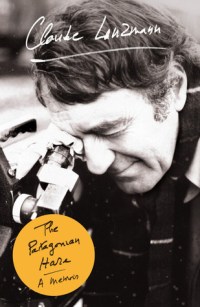
I watched Shoah to school myself. Initially, I attempted to watch it in installments at the university library but my practice was inconsistent. Years later, I read Lanzmann’s memoir, The Patagonian Hare. Learning about his fascinating life and the details behind the making of Shoah made the film seem less imposing. I ordered the Criterion edition from Amazon and holed myself up in my apartment one gray spring day. By mid-evening, I emerged tired and emotionally drained but full of desire to learn more about what I had seen. It had been so compelling and yet it felt like there was still so much more work to be done—Lanzmann was just scratching the surface.

Patagonian Hare

I soon began teaching segments of Shoah in my university classes. Initially, I was curious to see how they would respond to it and what kinds of discussions would ensue. Over time, I began selecting specific sections of the film and building outwards into history from them. For example, the longest single segment in the film is a forty-minute interview with Jan Karski, a former courier for the Polish Underground who recounts his secret visits to the Warsaw ghetto, which local Jewish leaders coordinated in a desperate attempt to get the word out about systematic Nazi atrocities to the Polish government-in-exile and the Allies. Years later, Lanzmann released an hour-long companion film based on unused interview footage from Shoah in which Karski details his wartime Oval Office meeting with President Franklin Delano Roosevelt about the Holocaust. I combined these pieces with Karski’s memoir, Story of a Secret State not only to immerse students in the life of an exceptional figure from the World War II era but also to pose difficult questions about human agency, acts of witnessing, and the possibility of stopping crimes against humanity once they are already in progress.
Each segment of Shoah is a portal to a wider history. My project is to flesh out as many of them as possible while reflecting on the film’s broader themes and style. My aim is to initiate a more authentic engagement with the Holocaust for a wide, informed audience using the film.

16161786

My project begins with a trip to Poland. My objective is twofold. First, Shoah is a very place-specific film and I am curious to see what these places look like today: the death camps of Auschwitz-Birkenau, Treblinka, Sobibor, Belzec, and Chelmno; the remnants of the Warsaw ghetto; the ruins of Jewish cemeteries in Lodz and Oswiecim; the villages around Chelmno and Treblinka where Lanzmann pointedly interviewed Polish peasants about what they saw and what they thought about the Jews. What do those places look like now as sites of memory?
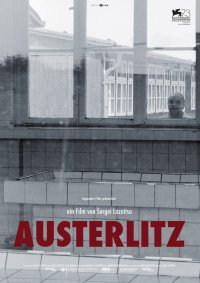
I am also interested in tourism and the Holocaust. Several years ago, I saw Sergei Loznitsa’s documentary Austerlitz (2016) through the L.A. Film Forum. The film mainly consists of long, black-and-white shots of summer tourist throngs visiting the Sachsenhausen concentration camp outside Berlin. Like Shoah, Loznitsa’s film eschews music, narration, and a clear message. Instead, it reveals an uneasy (and perhaps even darkly comic) combination of reverence and irreverence as the ruins of the past are encountered first-hand: in one segment, for example, a tour guide dramatically lectures in front of a crematorium oven and seconds later a tourist moves in and smiles for a picture. A sharp-eyed friend (and film graduate student) recalled another visitor in the film wearing a t-shirt bearing the inscription, “Cool Story, Bro.” I once suggested to my students that rather than visiting Auschwitz, many people might benefit more by staying home for a day and watching Shoah. I am traveling with that theory in mind.

DN9JronXcAEsDsB

My trip is a city-based, circular route around southeastern Poland—from Krakow to Lodz to Warsaw to Lublin and finally back to Krakow—over a two-week period. I will be posting frequently to share my thoughts, observations, and photos. Please feel free to email me any questions or suggestions to kurtmacm [at] gmail dot [com]. Thanks for reading!
Posted in Uncategorized | 2 Comments